+65 83551210
Most founders setting up a Hong Kong company spend weeks researching tax rates and banking options, then spend five minutes on the director appointment.
That's a problem. Because the director isn't just a box to tick on your incorporation form. Under the Companies Ordinance (Cap. 622), the director is the person the law holds accountable for everything that happens inside your company.
- Miss a filing deadline? That's on you;
- Take on debt the company can't repay? Still on you.
The good news: the rules are simpler than you think, once you actually understand them.
In this guide, you'll learn what a Hong Kong company director is, exactly who qualifies (hint: no residency required), what your legal duties look like in practice, and the one situation where a nominee director actually makes sense.
1. What is a director of a Hong Kong company?
A Hong Kong company director is a legally appointed individual who manages the company's affairs and acts on its behalf.
That's not just a governance title. The director signs contracts, approves financial statements, authorises major transactions, and ensures the company meets every statutory obligation under Hong Kong law. In short: the director is the legal face of the company.
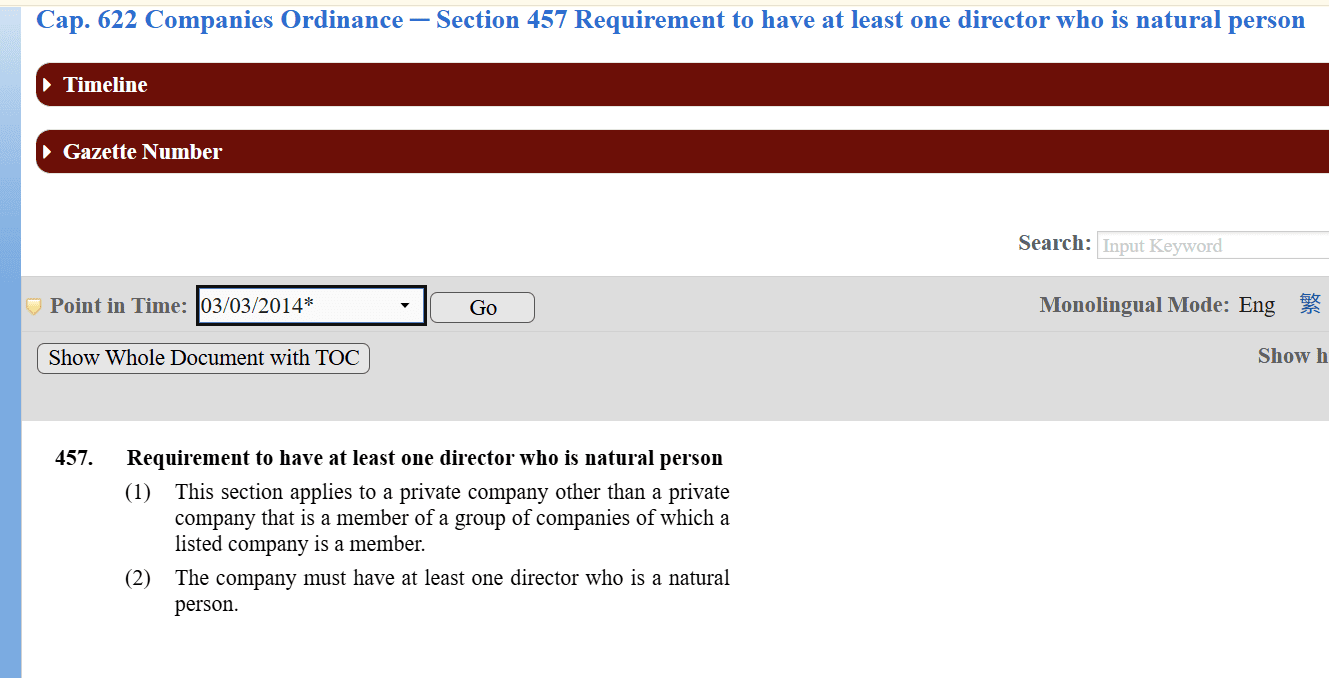
According to the Cap. 622 Companies Ordinance, section 457, every private limited company in Hong Kong must appoint at least one director before it can be incorporated.
What the difference between a director and a secretary of a Hong Kong company?
These 2 roles get confused constantly, but they're fundamentally different.
The director governs. They make decisions and bear legal responsibility for the company's compliance.
The company secretary administers. They maintain statutory records, file annual returns, and keep the Companies Registry updated.
Here's the rule that trips people up: if your company has only 1 director, that person cannot also serve as company secretary. You must appoint a separate individual or a licensed professional firm for the secretary role.
Ryan Strategic consultant of Global Link Asia Consulting
2. 5 types of directors in Hong Kong
Hong Kong law recognises several distinct director types:
- Executive director is involved in day-to-day management and holds an operational role.
- Non-executive director sits on the board but isn't involved in daily operations; provides oversight and strategic input.
- Shadow director is someone whose instructions the board habitually follows, even if they're not formally appointed; courts can treat shadow directors as legally responsible.
- Nominee director is a person appointed to act as director on behalf of the real beneficial owner, typically for privacy reasons
- Corporate director is a company (not an individual) appointed as director. It is permitted for private companies, but only if at least 1 individual director is also in place.
That last point matters. You can't run a Hong Kong company with only corporate directors. There must always be at least one natural person, a real human being on the board.
3. Who can be a director of a Hong Kong company?
Here's the fact that surprises most foreign founders: Hong Kong has no residency requirement for directors.
Unlike Singapore, where at least 1 director must be a local resident or Employment Pass holder, Hong Kong allows anyone of any nationality, based anywhere in the world, to serve as a company director. You can incorporate from Spain, manage from the U.S.
The eligibility requirements are straightforward:
- Must be a natural person (an individual, not just a corporation);
- Minimum age: 18 years old;
- Any nationality — no Hong Kong residency or work visa required;
- Cannot be bankrupt or have been convicted of relevant malpractices;
- No requirement to also be a shareholder.
There's no upper limit on the number of directors a company can have. You can start with 1 and add more as the business grows.
The question our experts often receive is that "Can one person be both director and shareholder?"
The answer is yes, and it's one of the most common structures for early-stage companies. A single individual can be the sole director and the sole shareholder of a Hong Kong private limited company. This keeps the structure clean and removes governance complexity at the early stage.
The one catch: that sole director cannot simultaneously be the company secretary. You'll need to engage a separate secretary.
Pro tip: If you're a solo founder keeping it simple, appoint yourself as director and shareholder, then engage a professional firm as your company secretary.
4. What are the legal duties of a Hong Kong corpoate director?
This is where most founders underestimate the role. Delegating tasks to your accountant, your company secretary, or a local manager is fine . But delegation doesn't transfer your legal responsibility.
As director, you remain accountable even for work you've handed off. Under the Companies Ordinance (Cap. 622), your core duties include:
- Act in good faith: Always in the company's best interests, not your personal ones
- Exercise independent judgment you can take professional advice, but you can't simply rubber-stamp it
- Avoid conflicts of interest: Disclose any personal interest in transactions before they're approved
- Maintain accurate financial records: The company's books must be kept to a standard that reflects its true financial position
- Ensure annual audits: All Hong Kong companies must have their accounts audited annually by a certified public accountant
- File statutory documents on time: The Annual Return (Form NAR1) must be filed within 42 days of the company's incorporation anniversary; any director change must be notified on Form ND2A within 15 days
- Avoid fraudulent trading: Don't take on credit obligations you know the company can't meet
If you breach any director duties, the consequences range from financial penalties to criminal prosecution, depending on what went wrong:
- Civil liability: you can be personally sued for losses caused by a breach of fiduciary duty
- Criminal prosecution: false statements, fraud, and failure to file statutory documents can lead to fines or imprisonment
- Regulatory fines: late filings or Significant Controllers Register (SCR) breaches carry fines up to HK$25,000, plus HK$700 per day for continuing offences
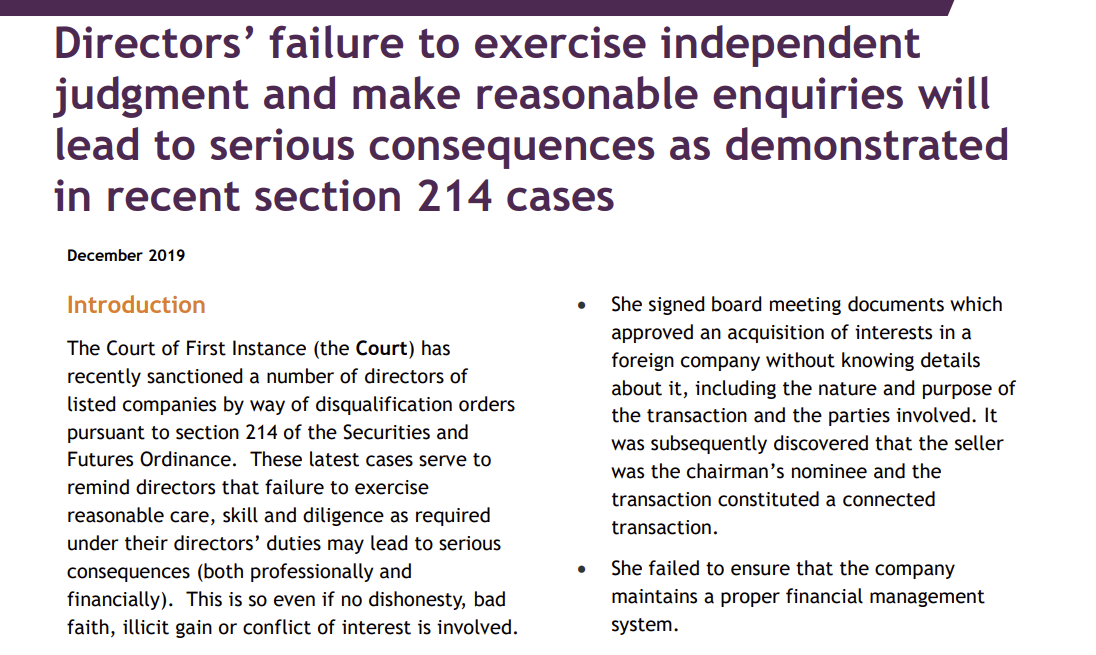
Real cases of Hong Kong directors breaching any director duties
5. When do you need to have a nominee director for your Hong Kong company?
Most people searching for nominee directors in Hong Kong are doing so because they believe Hong Kong requires a local resident director. It doesn't. There is no residency requirement in the Companies Ordinance. If that's the only reason you're considering a nominee, you don't need one.
That said, nominee directors do serve legitimate purposes.
When you incorporate a Hong Kong company, your name as director appears on the public Companies Registry.
If you want to keep your identity off that public record, because you're managing multiple ventures, protecting a competitive position, or simply prefer privacy. anominee director puts their name on the public register instead.
Please remember that your identity as ultimate owner isn't hidden from authorities. It's recorded in the company's Significant Controllers Register (SCR), which is kept at the registered office and is accessible only to law enforcement, not the general public.
Other legitimate reasons to appoint a nominee:
- You need a practical local point of contact for administrative correspondence;
- You're managing subsidiaries and want consistent board representation ac.oss entities;
- Your bank or counterparties want to see a named local representative,
However, please note that hiring a nominee director comes with disadvantages
A nominee director is still a director. Under Hong Kong law, they owe the same fiduciary duties as any other director — regardless of any private agreement you have with them.
Using a nominee structure to hide assets, evade tax, or launder money is a criminal offence. Both the beneficial owner and the nominee face prosecution.
Banks increasingly scrutinise nominee director structures during account opening. Expect additional KYC (Know Your Customer) documentation and potentially longer timelines.
6. Compliance deadlines every director must know
One of the most practical things you can do as a director is put these dates in your calendar the moment your company is incorporated.
We see this issue quite often with foreigners who choose to open a company on their own to save costs. While the intention is understandable, some important tasks and deadlines are often overlooked during the process.
To help, our experts have prepared a deadline checklist so you can track key requirements more easily.
| Filling | Deadline | Filed with |
| Annual return (Form NAR1) | Within 42 days of incorporation anniversary | Companies Registry |
| Director appointment/change (Form ND2A) | Within 15 days of the change | Companies Registry |
| Business Registration renewal | Annually or every 3 years | Inland Revenue Department |
| Annual audit | Before annual return filing | CPA-certified auditor and IRD |
7. How can we help you appoint a director for your Hong Kong company?
The founders running clean, compliant Hong Kong companies aren't doing it with guesswork or last-minute panic filings. They're structured correctly from day one because they understood the director role before they signed anything.
The director isn't a formality. It's the legal anchor of your entire company.You don't need to overhaul everything at once.
Start small:
- Confirm your director appointment at incorporation: name, role, filed correctly
- Set a calendar reminder for your NAR1 deadline (42 days after your incorporation anniversary)
- Engage a trusted service provider as company secretary to help you build a sustainable business.
When you're ready to go deeper on structuring your Hong Kong company the right way, check out our complete guide to One-stop Hong Kong company incorporation.
In addition, we offer an all-in-one package service you can trust:
- Open a company in Hong Kong legally, fast with our one-stop support
- Get a reliable, experienced company secretary with our corporate secretarial service
- Support in opening your business bank accounts;
- Get an affordable, professional registered office address for your business;
- Support to open, authenticate, and manage Stripe and PayPal Business in Singapore, Hong Kong, and the U.S;
- Handle all your tax accounting needs, timely annual filings, auditing, and more.
Whether you’re a solopreneur, startup, or scaling business, we’ll make sure your Hong Kong setup is fully compliant, optimized, and affordable.
8. FAQs about Hong Kong company director
You can check the directors of a Hong Kong company through the official Hong Kong Companies Registry website, using Search. For example: Companies registered under Companies Ordinance and Directors Index.
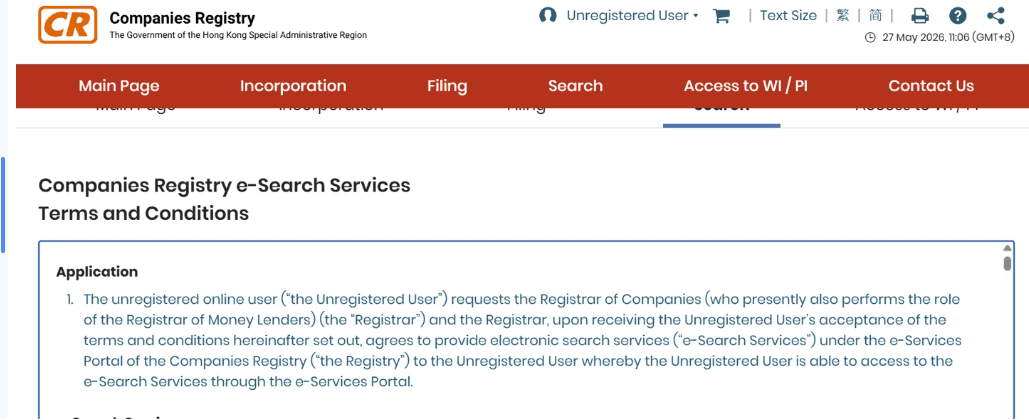
E-services from CR website
Please remember that the information is public, but controlled
The registry allows public searches, but:
- You must provide your name and ID/passport information
- You must state why you are searching
- You can only use the data for legal/business purpose
This is because Hong Kong tightened privacy rules around company searches. In addition, you may have to pay to seach on the goverment database.
Foreigners and non-residents can still have tax obligations in Hong Kong if they operate a Hong Kong company.
- Director salaries and director’s fees from a Hong Kong company may be subject to Hong Kong Salaries Tax, regardless of nationality or residency;
- Dividends are generally not taxable under Salaries Tax and do not usually require MPF contributions;
- Salary expenses are usually tax deductible for the company, while dividends are not.
Having 100% overseas clients does not automatically qualify the company for offshore tax exemption. The Inland Revenue Department looks at where the business activities and profit-generating operations take place.
MPF obligations depend on the employment arrangement and exemption rules. More details are available from the MPFA Official Website.
Each company structure and tax situation is different. For specific advice based on your business activities, compensation structure, and residency status, you should consult a qualified Hong Kong tax professional. Our experts can help you with that.
With over a decade of experience serving as a trusted partner to more than 750 business owners seeking professional development and breakthroughs in the international market, we are an expert strategic corporate service provider helping you incorporate and operate successfully in 10 different countries
Our areas of expertise include:
- Strategic Consulting and Company formation in over 10 different countries worldwide such as Singapore, Hong Kong, the U.S., Australia, Thailand, Malaysia, and offshore destinations like BVI, Belize, Seychelles, and more.
- Account opening for personal and corporate bank accounts, as well as setting up PayPal and Stripe gateqays in countries like Singapore, Hong Kong, and the U.S..
- Tax Consulting and Preparation for SFRS IFRS financial reports, corporate income tax returns, VAT/GST (Value Added Tax/Goods and Services Tax), and more.
- Opreation support:
- Registered adress;
- Foreign consular legalization;
- Trademark and patent protection registration in Singapore and the US;
- Employment Pass application in Singapore and Hong Kong;
- Website design, international SIM number provision;
- DUNS registration.
With over 10 years of experience and a team of experts with 5 to 25 years of experience (international standard certifications) as well as direct partnerships with institutions such as OCBC, UOB, DBS, PayPal, and Stripe, we are proud to offer professional, legal, transparent, sustainable services with no hidden costs.


Global Link Asia Consulting Pte. Ltd. is pleased to announce the publication of the above insightful and informative article on our official website, Global Link Asia Consulting on 29th May 2026. The copyright for this article is exclusively held by Global Link Asia Consulting Pte. Ltd. Any unauthorized reproduction or distribution of this content without our express written permission is strictly prohibited. We value the protection of our intellectual property and appreciate your cooperation in adhering to these guidelines. Thank you for your continued support of Global Link Asia Consulting Pte. Ltd.
The content in this article is provided by Global Link Asia Consulting for general informational purposes only. It is intended as a helpful reference and should not be considered legal, tax, accounting, banking, or other professional advice. Because laws and regulations can change, and every situation is different, we recommend that individuals and businesses seek independent professional advice before making any important decisions. Global Link Asia Consulting is not responsible for any loss or damage that may result from relying on the information in this article without obtaining appropriate professional advice.
 470 North Bridge Road, #05-12, Bugis Cube, Singapore (188735).
 Unit 308, 3/F, Chevalier House, 45-51 Chatham Road South, Tsim Sha Tsui, Hong Kong.
 90/14-17 Sathorn Thani Building 1, 8th Floor, North Sathorn Road, Silom, Bangrak, Bangkok 10500.
 12th, Felix Alley Building, 151/1-2 Nguyen Van Troi, Phu Nhuan District, Ho Chi Minh City, Vietnam.