+65 83551210
If you hear anyone saying selling on Amazon is easy. They are dead wrong.
Selling on Amazon as a foreigner isn’t just about opening an account anymore. It’s about structuring your business the right way.
In 2026, Amazon sellers without a U.S. company are running into more barriers than ever.
- Stricter KYC;
- Bank account verification;
- Tax and compliance checks that weren’t enforced a few years ago;
- Heavy investment upfront (from advertising, legal setup, to logistics) to keep your store running in the first year.
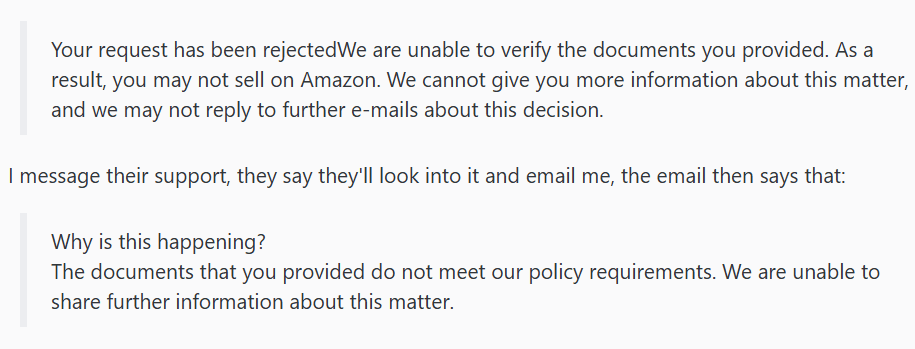 This is the email we received from one of the customers we supported
And this shift is showing up in seller suspensions and slow verification. Our experts at Global Link Asia Consulting reviewed hundreds of Amazon account cases.
Some we supported with success. Others showed risks so high that we had to turn down during the KYC process. Those hard cases had one thing in common: No properly structured U.S. company behind the seller account.
This isn’t an isolated issue. We had to consult more and more foreign sellers to form U.S. companies before launching on Amazon. And the reason goes deeper than compliance.
In 2026, selling on Amazon as a foreigner requires more than a product and a listing.
In this guide, you’ll learn:
- Whether you really need a U.S. company to sell on Amazon;
- How foreigners can legally set up and operate a U.S. company.
First, let's begin by understanding why more and more sellers choose to sell on Amazon.
1. Why are more and more people selling on Amazon?
Selling on Amazon means selling directly to consumers through the world’s most powerful e-commerce marketplace. And that marketplace keeps getting bigger.
1.1. Market potential
In 2024, U.S. online retail sales surpassed US$1 trillion, and Amazon captured a dominant share of that growth.
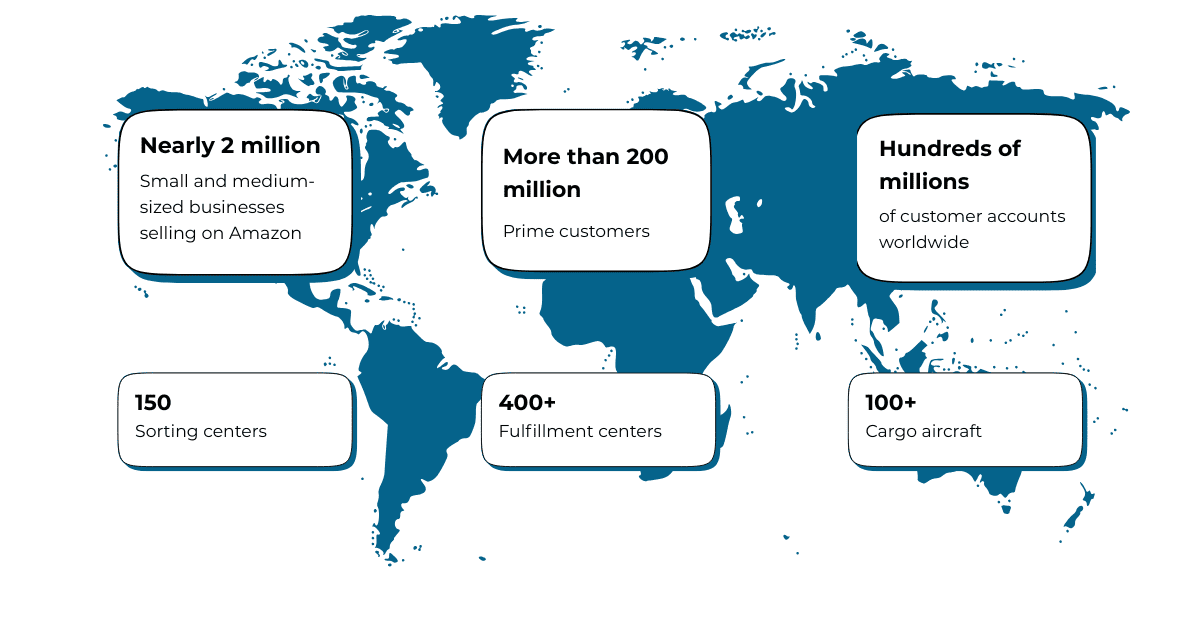
Amazon growth over the years
But here’s the part many people miss: Amazon is no longer driven mainly by big brands. More than 60% of Amazon’s total sales now come from independent sellers, most of them small and medium-sized businesses.
That shift explains why entrepreneurs around the world are moving to Amazon. Amazon offers what most platforms can’t combine in one place:
- Massive demand;
- Built-in customer trust;
- World-class logistics (Amazon has launched a new service called Amazon Global Logistics - AGL);
- Scalable growth potential.
Instead of building traffic from scratch, sellers plug into an ecosystem with hundreds of millions of ready-to-buy customers.
And Amazon does the hard parts.
- Storage;
- Shipping;
- Returns;
- Customer service.
Programs like Fulfillment by Amazon (FBA) allow even solo founders to operate like large enterprises, without owning warehouses or hiring logistics teams.
1.2. Omnichannel opportunity in the U.S
Amazon is a powerful marketplace. But the most successful sellers don’t rely on Amazon alone. They build systems that sell across multiple platforms, while keeping operations centralized.
That’s where omnichannel selling comes in. Amazon supports this approach with tools designed to extend sales, logistics, and marketing beyond its own marketplace.
In addition to being Amazon sellers, sellers can expand into channels like Walmart Marketplace and TikTok Shop, turning Amazon into the operational backbone, not the only storefront.
 Sellers are looking for opportunities to sell on Walmart
2. Should you sell as an individual or as a business on Amazon U.S?
This is the first reason most Amazon sellers fail, or struggle to survive beyond years 2–3. They choose to sell as an individual on Amazon. At the beginning, everything looks fine.
The account is approved. Sales come in. Nothing seems wrong. Until legal and tax issues appear.
And by the time they do, most sellers are already too deep to fix them easily. Most sellers who do eventually pay the price, through legal exposure, tax complications, or forced restructuring.
On the one hand, selling personally may work in the short term, but it creates long-term risks that many founders don’t see until it’s too late.
On the other hand, incorporating a company in the U.S is the foundation that allows an Amazon business to scale, stay compliant, and survive beyond the early years.
To see the difference clearly between selling as an individual and as a business, our experts create the comparison table below for you:
| Factors to consider | Selling personally (Individual/Sole proprietor) | Selling via an U.S company |
| Setup speed | Fast and simple to start | Slightly more setup, but structured |
| Legal liability | No separation between you and the business. You are 100% responsible for your business. | Limited liability protects personal assets |
| Personal asset risk | High, personal assets are exposed | Low, business risk stays within the company |
| Product liability exposure | Very high (especially for private-label products) | Significantly reduced with legal separation |
| Amazon verification & trust | Basic profile, higher scrutiny over time | More credible structure, smoother reviews |
| Business banking | Limited or difficult to separate finances, hard to calculate personal income tax, business income tax, sales tax to pay to the IRS Hars to separate between paying tax in the U.S and paying tax for your country of residence | Easy access to U.S. business bank accounts Easy to sepate personal and business income Easy to calculate tax. |
| Accounting & Record-Keeping | Mixed personal and business finances | Clean, compliant financial separation |
| Tax planning flexibility | Testing, short-term, low-risk products | Serious sellers aiming to scale with our expert support |
2.1. Selling Personally: Fast to start, risky to scale
Amazon allows you to register as an individual by selecting “None, I am an individual” and using your Social Security Number. This option is often chosen by first-time sellers because it feels simple. You may need to contact Amazon Global Selling for support. But it offers minimal protection.
There is no legal separation between you and the business. Any dispute, claim, or investigation points directly to you as an individual.
For sellers of physical products, especially private-label products, this becomes a serious problem as the business grows.
That’s why many sellers hit a wall around year 2 or 3, not because the product failed , but because the structure couldn’t support growth.
2.2. Selling as a business: Our recommendation
For sellers who want to scale, and survive long term, a U.S. Limited Liability Company (LLC) or a US Corporation is the most practical structure, especially for non-U.S. residents.
If you need help with company structuring for maximum protection, tax optimization and efficient operations, our experts can offer you our unique advice, based on hundreds of clients we helped buil long-term business models.
Opening a company in the United States and selling on Amazon has 3 important advantages:
This is the most important advantage.
When you sell as an individual or DBA, there is no separation between personal and business assets.
If the business is sued, your personal assets are exposed. A company changes that.
It creates a legal boundary between you and the business. If the company faces a claim, your personal assets are protected.
This is critical for:
- Physical products;
- Consumable goods;
- Private-label brands.
In these cases, the seller is often treated as the manufacturer or importer, meaning full product liability applies. Without a company , the risk is personal.
An incorporated company also makes the business easier to operate.
- A company simplifies opening a U.S. business bank account, allowing you to keep business and personal finances separate—essential for compliance and reporting;
- Operating under an LLC/A corporation increases trust with partners, payment providers, and platforms like Amazon;
- A U.S. company structure makes it smoother to ship inventory into Amazon fulfillment centers, especially when using FBA.
- Even though Amazon collects and remits most sales tax under marketplace facilitator laws, a company provides a clearer framework for handling U.S. tax and reporting obligations.
3. How to open a U.S company for Amazon selling (the right way)
Explore deeper
Incorporating a company in the U.S. can open powerful opportunities, but only when it’s done right from the start. From choosing the right state to structuring taxes and compliance properly, the details matter more than most founders expect.
If you’d like a clearer, step-by-step understanding, we invite you to explore our in-depth guide on incorporating a company in the U.S., where we break down the process, common pitfalls, and practical tips for international founders.
And if you’re ready to move from research to action, our one-stop service is designed to support you end to end—from incorporation and compliance to banking and ongoing support—so you can focus on growing your business with confidence.
Now that you know the drawbacks and the benefits of selling on Amazon with a U.S company.
Our experts will show you in this section how you can incorporate a company the correct way in this section (An overview). You can set up a U.S. company on your own. But sellers who do usually learn the hard way.
- Miss one detail, and Amazon delays your approval.
- Choose the wrong structure, and legal risk shows up later.
- Use the wrong address, and your seller account gets rejected.
With expert guidance, those risks drop to the lowest possible level. And your time to market shortens significantly, meaning faster sales, higher ROI, and earlier scale.
{moduleid 1567}
4. Bonus: 3 pratical tips to go faster with our Amazon Seller account
Most new Amazon sellers focus only on getting approved. Smart sellers focus on getting approved fast and surviving long enough to scale.
Here are four practical tips that separate sellers who stall from those who reach profitability faster. These tips are what we concluded after interviewing our most successful Amazon sellers who have built their empire from the ground-up, with our ongoing support as a partner.
4.1. Plan your finance for a heavy first year (This is non-negotiable)
The first year of selling on Amazon is cost-intensive. This is where many sellers underestimate the game, and run out of cash before optimization kicks in.
In Year 1, your main costs typically include:
- Product sourcing and procurement;
- Manufacturing or private-label production;
- Shipping and international logistics;
- Amazon FBA storage and fulfillment fees;
- Advertising (PPC is mandatory, not optional);
- Software tools and compliance costs.
During this phase, profits are often thin, or negative. And that’s normal.
The real return usually comes in Year 2, once:
- Listings are optimized;
- Reviews accumulate;
- Advertising becomes more efficient;
- Supply chains stabilize.
As optimization improves, costs go down while margins go up. Amazon is not a quick-win platform. It’s a scale-and-optimize business.
To start, you can use our table below to get the estimated cost to start building your store on Amazon.
Please note that fee ranges based on your currency and service fees of Amazon branch in your country. Some sellers may incur additional fees, such as long-term storage fees or optional program fees, including advertising costs and premium account services.
4 types of selling fees on Amazon (in USD)
| Account maintenance fee | $0.99 – $39.99 |
| Fulfillment fee (FBA) | From $2.35 / unit |
| Referral fee | 8% – 15% |
| Storage fee | $0.48 – $2.40 / cubic foot |
4.2. Register for Amazon Brand Registry
Brand Registry does more than unlock features. It fundamentally changes how much control you have over your listings and brand presence.
Trademark registration is important in the U.S
To be an experienced seller on Amazon, you should:
- Start the trademark process early
- Align the brand name with long-term product plans
- Avoid last-minute delays that slow Brand Registry enrollment
Brand Registry is a growth lever, but only if the groundwork is done correctly
Brand Registry allows you to protect your intellectual property and actively monitor unauthorized use of your brand. Only sellers with the Brand Registry selling role can create or control new product detail pages under the enrolled brand—reducing hijacking and listing abuse.
Enrolled brands gain access to A+ Content, enabling richer product pages with visuals, comparison charts, and storytelling elements.
These enhanced listings consistently improve conversion rates compared to standard text-only pages.
4.3. Leveraging Fulfillment by Amazon (FBA)
Fulfillment by Amazon (FBA) is the backbone of scalable Amazon operations.
With FBA, you send inventory to Amazon’s fulfillment centers—and Amazon handles: storage, packing, shipping, customer service, and returns This allows sellers to focus on growth, not logistics and risky FBM.
Be careful with accounting in the U.S.
Inventory is treated differently under U.S. accounting and tax rules.
When you use FBA, your inventory is stored in Amazon fulfillment centers, which creates accounting and tax implications, even if you never set foot in the U.S.
Because Amazon may move and store your inventory across multiple states, sellers need to:
- Track inventory by location;
- Account for inventory correctly under U.S. standards;
- Ensure compliance with state-level tax and reporting requirements.
- Work with an experienced CPA who understands Amazon, FBA to deal with your business accounitng like Global Link Asia Consulitng
5. How can we help you build a successful Amazon store in the US as a foreigner?
Building an Amazon store in the US works best when it’s part of a complete, well-structured system—not something done in isolation.
Once the foundation is set, combine the right legal setup, product strategy, and smart marketing to scale with confidence.
That’s when Amazon stops being just another marketplace and becomes a long-term business that grows your revenue and credibility in the US as a foreigner.
With 10 years of experience helping foreign business owner thrive on Amazon with our strategy from legal setup to business operations, we can help you:
- Register a company in the U.S in your chosen state;
- Open a corporate bank account in the U.S with a 99% success rate;
- Choose the right company types for tax optimization in the U.S;
- Apply for US business licenses;
- Get an affordable, professional registered office address for business;
- Support to register DUNS Number for SaaS Businesses in Delaware
- Support to open, authenticate, and manage Stripe Paypal Business in Singapore, Hong Kong, and the U.S;
- Handle all your tax accounting needs, timely annual filings, auditing, and more.
6. FAQs about selling on Amazon with a company in the U.S
You're mostly covered Amazon collects and remits sales tax on your behalf in all marketplace facilitator states (which is nearly all of them now).
So, if you’re only selling via Amazon FBA and not on other platforms, you generally don’t need to register or file sales tax returns. Just keep records in case states ever ask. Always good to double-check with a tax pro to stay safe
FBA is generally recommended for sellers aiming for scalability and those located outside the US.
FBA outsources all logistics (storage, packaging, shipping, returns, customer service) to Amazon, and most importantly, makes your products Prime eligible, which significantly increases consumer confidence and sales conversion. FBM means you manage all fulfillment from your own warehouse
The Professional plan costs $39.99 per month, while the Individual plan charges $0.99 per item sold. If you plan to sell 40 or more items per month, the Professional plan is more economical,.
The Professional plan is also required to access essential growth tools like Brand Stores, Sponsored Brands, display ads, and managing inventory via spreadsheets
With over a decade of experience serving as a trusted partner to more than 750 business owners seeking professional development and breakthroughs in the international market, we are an expert strategic corporate service provider helping you incorporate and operate successfully in 10 different countries
Our areas of expertise include:
- Strategic Consulting and Company formation in over 10 different countries worldwide such as Singapore, Hong Kong, the U.S., Australia, Thailand, Malaysia, and offshore destinations like BVI, Belize, Seychelles, and more.
- Account opening for personal and corporate bank accounts, as well as setting up PayPal and Stripe gateqays in countries like Singapore, Hong Kong, and the U.S..
- Tax Consulting and Preparation for SFRS IFRS financial reports, corporate income tax returns, VAT/GST (Value Added Tax/Goods and Services Tax), and more.
- Opreation support:
- Registered adress;
- Foreign consular legalization;
- Trademark and patent protection registration in Singapore and the US;
- Employment Pass application in Singapore and Hong Kong;
- Website design, international SIM number provision;
- DUNS registration.
With over 10 years of experience and a team of experts with 5 to 25 years of experience (international standard certifications) as well as direct partnerships with institutions such as OCBC, UOB, DBS, PayPal, and Stripe, we are proud to offer professional, legal, transparent, sustainable services with no hidden costs.


Global Link Asia Consulting Pte. Ltd. is pleased to announce the publication of the above insightful and informative article on our official website, Global Link Asia Consulting on 18th December 2025. The copyright for this article is exclusively held by Global Link Asia Consulting Pte. Ltd. Any unauthorized reproduction or distribution of this content without our express written permission is strictly prohibited. We value the protection of our intellectual property and appreciate your cooperation in adhering to these guidelines. Thank you for your continued support of Global Link Asia Consulting Pte. Ltd.
The content in this article is provided by Global Link Asia Consulting for general informational purposes only. It is intended as a helpful reference and should not be considered legal, tax, accounting, banking, or other professional advice. Because laws and regulations can change, and every situation is different, we recommend that individuals and businesses seek independent professional advice before making any important decisions. Global Link Asia Consulting is not responsible for any loss or damage that may result from relying on the information in this article without obtaining appropriate professional advice.
 470 North Bridge Road, #05-12, Bugis Cube, Singapore (188735).
 Unit 308, 3/F, Chevalier House, 45-51 Chatham Road South, Tsim Sha Tsui, Hong Kong.
 90/14-17 Sathorn Thani Building 1, 8th Floor, North Sathorn Road, Silom, Bangrak, Bangkok 10500.
 12th, Felix Alley Building, 151/1-2 Nguyen Van Troi, Phu Nhuan District, Ho Chi Minh City, Vietnam.