+65 83551210
You've found a business opportunity. You need a company registered in Hong Kong, Singapore, the UK, or other jurisdictions, and you need it this week.
A shelf company sounds perfect. Already incorporated. No paperwork queue. Ready to go.
But here's the thing you should take into consideration: the case for buying a shell company overseas is not as compelling in 2026 as it was a decade ago, and the risks are far higher than you think.
In other words, we suggest you should not buy a shelf company. That doesn't mean you should never do it. It means you need a clear framework before you sign anything.
In this article from our experts, you'll learn what a shelf company actually is, why people buy them overseas, the risks that can wreck you, how to decide whether to buy or incorporate fresh, and the 7 due diligence checks that separate a smart acquisition from an expensive mistake.
Let's get into it.
1. What is a shelf company?
A shelf company (also called a ready-made company or aged corporation) is a business entity that has been legally registered in a jurisdiction but has never traded.
Ideally, a shelf company should have no revenue, no contracts, no debt and any negative history. It was created specifically to be sold (placed on a "shelf" to wait for a buyer).
When you buy one, you acquire the existing legal entity: its registration number, its incorporation date, and its corporate history. You change the name, update the directors, and you're operational.
You may come across another term when searching for a shelf company: shell company. What is the difference between these two terms?
These two terms get used interchangeably online. They mean different things, and confusing them is how buyers end up inheriting problems they didn't expect.
The critical difference here is that a shell company that has traded carries a full transaction history: invoices, contracts, potential tax disputes, and legal claims. A true shelf company has none of that.
The problem? Unscrupulous providers sometimes sell pre-owned shell companies with rich histories as if they were clean shelf companies. You think you're buying a blank slate. You're actually inheriting someone else's mess.
| Shelf company | Shell company | |
| Trading history | Never traded | May or may not have traded |
| Liabilities | Should be zero | Often has existing obligations |
| Purpose | Sold off-the-shelf for quick setup | Holds assets, IP, or is used for structuring |
| Risk level | Low if verified; | Ranges from low to very high |
Is a shelf company the same as a dormant company?
The answer is yes. A dormant company is any registered business that has temporarily stopped trading. It may have operated in the past, accumulated debts, signed contracts, or held assets before going dormant, and remains till it becomes active again.
Shelf company: Person A incorporates a company in 2023, keeps it inactive, and sells it to you in 2026 through share transfer or other methods.
Dormant company: A business starts trading in 2022, stops operating in 2025, but keeps the company registered for future use.
The only difference is that a dormant company is usually your own company that stops operating, whereas a shelf company is sold to you to use.
Ryan_Company formation expert of Global Link Asia Consulting
2. Why do entrepreneurs buy shelf companies overseas?
There are two legitimate reasons entrepreneurs buy ready-made companies in foreign jurisdictions.
The promise is simple: skip the weeks-long incorporation queue and be operational within 24–48 hours. It was a compelling advantage in 2010.
Today, it rarely holds up. Australia registers new companies in under 10 minutes. The UK's Companies House processes online incorporations in 24–48 hours. Singapore's ACRA handles most registrations within 1–3 business days.
Speed is only a genuine advantage in jurisdictions with slow, bureaucratic incorporation timelines. Before paying a premium for "instant availability," check how long new company incorporation actually takes in your target country.
A company registered in 2018 simply looks more established than one incorporated this month, and some entrepreneurs want that perception working in their favor with banks, clients, and potential partners. This is simply not the case anymore
Credit bureaus can flag a company as being under new management, effectively resetting its perceived history from a lending standpoint.
Banks run their own due diligence, and a company showing a sudden change in directors and shareholders is going to invite questions rather than confidence.
Contract and banking readiness rounds out the list.
Some shelf companies come with existing bank accounts, VAT registration, or established banking relationships, making them attractive to businesses that need to be invoicing and collecting payments immediately.
This is where you need to be most careful. An account opened under a previous owner carries that owner's risk profile, and banks are required to perform enhanced due diligence on companies with unclear or opaque histories. What a seller presents as a ready-to-use asset, a bank compliance officer will likely treat as a red flag.
3. The real risks of buying a shelf company in a foreign country
The risks of buying an offshore shelf company don't come from the concept itself. They come from what you don't know about the company's history.
Based on our experts experience, consulting many busines owners on why they should not buy a shelf company, the risks include hidden liabilities, outdated registry data, consequences of prior questionable activities, opacity from nominee services, and regulatory exposure from the buyer's home country.
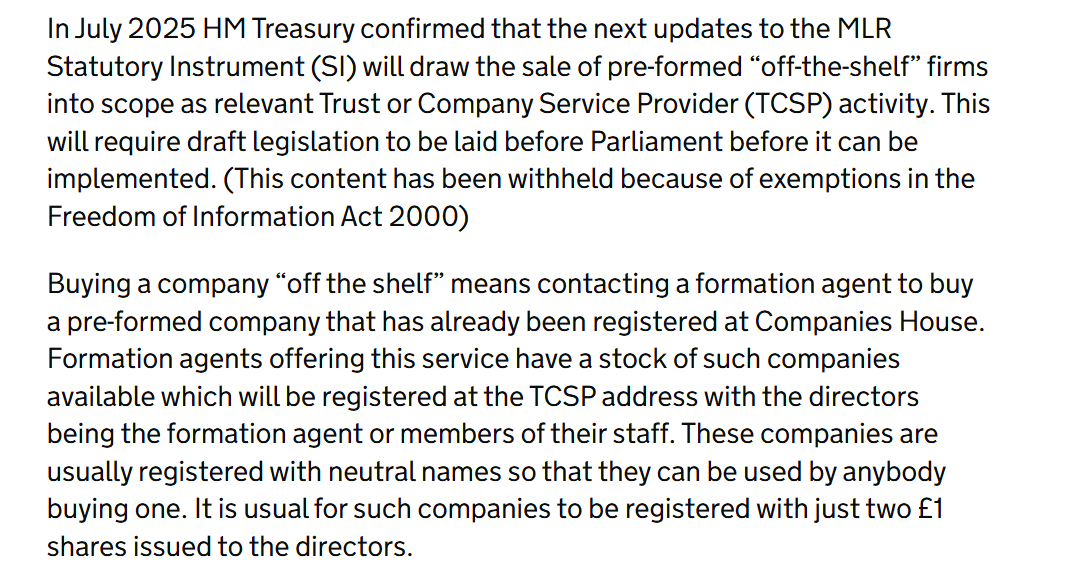
In July 2025 HM Treasury confirmed that the next updates to the MLR Statutory Instrument (SI) will draw the sale of pre-formed “off-the-shelf” firms
Here's how each of those plays out in practice.
| Risks | Why you should be carefull |
| Hidden liabilities | A shelf company is supposed to have zero liabilities. Previous owners or service providers may have used the company to sign contracts, open accounts, or incur obligations that aren't immediately visible. VAT debts in particular can be colossal, and they follow the entity, not the previous owner. |
| Company control | Shelf companies are offered with pre-arranged nominee directors and shareholders. The pitch is privacy: your name doesn't appear in the registry. Local law in many countries treats registered shareholders as actual shareholders. Nominee shareholders have full legal rights to the company. You may be paying for an entity you don't actually control. |
| AML and Compliance scrutiny | Regulators worldwide, guided by FATF (Financial Action Task Force) standards treat sudden changes in corporate ownership with heightened scrutiny. A company that changes all its directors and shareholders overnight is, by definition, suspicious-looking. |
| Loss of trust | Banks may refuse to open new accounts or may freeze existing ones pending enhanced due diligence. Enterprise clients and some government agencies now run their own KYC checks on vendors. A company that shows a recent abrupt ownership change will raise questions. |
4. How can we help you open and run your company overseas?
The shelf company pitch is ideal: an established entity, a foreign jurisdiction, operational from day one. But the more you examine it, the thinner the value proposition becomes.
You don't need to buy someone else's dormant company to go global. You can incorporate a new entity under your own name, in your chosen jurisdiction, with a clean history that belongs entirely to you.
That matters more than most people realize when they're chasing speed. A company built on a clean foundation is easier to bank, easier to scale, and far easier to exit or transfer when the time comes. Investors and partners aren't just looking at how old your entity is, they're looking at who built it and how it was run from day one.
If you're ready to set up your company the right way, we can help. We provide full support, from start to finish:
- Register a company in the U.S, Hong Kong and BVI;
- Open a corporate bank account with a 99% success rate;
- Choose the right company types for tax optimization;
- Apply for business licenses;
- Get an affordable, professional registered office address for business;
- Support to open, authenticate, and manage Stripe Paypal Business in Singapore, Hong Kong, and the U.S;
- Handle all your tax accounting needs, timely annual filings, auditing, and more.
5. FAQs about shelf companies
Yes,buying a shelf company in a foreign jurisdiction is legal.
The key legal obligations you must follow are: disclosing the change of beneficial ownership as required by local law, updating the corporate registry, and complying with any reporting requirements in your home country (such as CFC rules or controlled foreign company disclosures).
You can open a bank account with a shelf company; however, the process of opening one is heavily scrutinized by banks.
Banks in most jurisdictions conduct their own KYC and AML checks on new account holders, including companies. A shelf company with a recent ownership change will typically face enhanced due diligence before a bank opens or continues an account.
In most cases: no. For most jurisdictions, new company incorporation is faster, cheaper, and lower-risk than buying a shelf company.
With over a decade of experience serving as a trusted partner to more than 750 business owners seeking professional development and breakthroughs in the international market, we are an expert strategic corporate service provider helping you incorporate and operate successfully in 10 different countries
Our areas of expertise include:
- Strategic Consulting and Company formation in over 10 different countries worldwide such as Singapore, Hong Kong, the U.S., Australia, Thailand, Malaysia, and offshore destinations like BVI, Belize, Seychelles, and more.
- Account opening for personal and corporate bank accounts, as well as setting up PayPal and Stripe gateqays in countries like Singapore, Hong Kong, and the U.S..
- Tax Consulting and Preparation for SFRS IFRS financial reports, corporate income tax returns, VAT/GST (Value Added Tax/Goods and Services Tax), and more.
- Opreation support:
- Registered adress;
- Foreign consular legalization;
- Trademark and patent protection registration in Singapore and the US;
- Employment Pass application in Singapore and Hong Kong;
- Website design, international SIM number provision;
- DUNS registration.
With over 10 years of experience and a team of experts with 5 to 25 years of experience (international standard certifications) as well as direct partnerships with institutions such as OCBC, UOB, DBS, PayPal, and Stripe, we are proud to offer professional, legal, transparent, sustainable services with no hidden costs.


Global Link Asia Consulting Pte. Ltd. is pleased to announce the publication of the above insightful and informative article on our official website, Global Link Asia Consulting on 01st June 2026. The copyright for this article is exclusively held by Global Link Asia Consulting Pte. Ltd. Any unauthorized reproduction or distribution of this content without our express written permission is strictly prohibited. We value the protection of our intellectual property and appreciate your cooperation in adhering to these guidelines. Thank you for your continued support of Global Link Asia Consulting Pte. Ltd.
The content in this article is provided by Global Link Asia Consulting for general informational purposes only. It is intended as a helpful reference and should not be considered legal, tax, accounting, banking, or other professional advice. Because laws and regulations can change, and every situation is different, we recommend that individuals and businesses seek independent professional advice before making any important decisions. Global Link Asia Consulting is not responsible for any loss or damage that may result from relying on the information in this article without obtaining appropriate professional advice.
 470 North Bridge Road, #05-12, Bugis Cube, Singapore (188735).
 Unit 308, 3/F, Chevalier House, 45-51 Chatham Road South, Tsim Sha Tsui, Hong Kong.
 90/14-17 Sathorn Thani Building 1, 8th Floor, North Sathorn Road, Silom, Bangrak, Bangkok 10500.
 12th, Felix Alley Building, 151/1-2 Nguyen Van Troi, Phu Nhuan District, Ho Chi Minh City, Vietnam.