+65 83551210
Southeast Asia's startup scene is exploding.
And Thailand is quietly becoming the region's most underrated launchpad for tech and SaaS founders.
Low overhead. A booming digital economy. Government incentives that can cut your tax bill to zero. And a quality of life that San Francisco can't touch for the price.
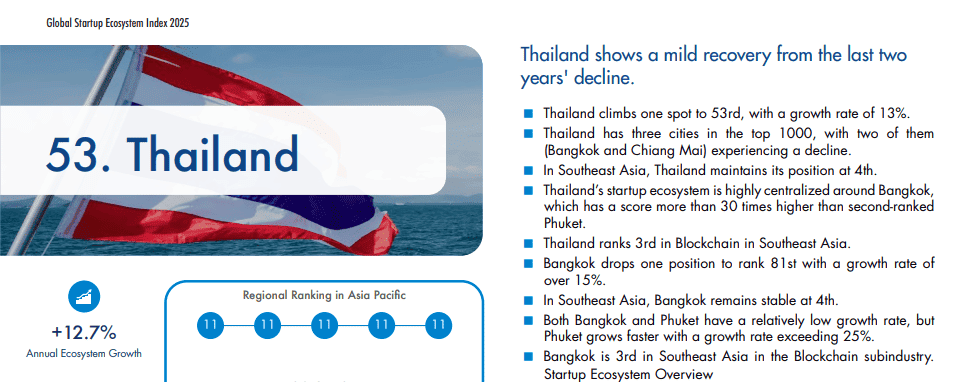
An overview of Thailand ecosystem support (Source: Global Startup Ecosystem Index 2025)
But here's the truth: setting up a company in Thailand isn't as simple as filing some paperwork online.
There are structures to choose from, visa requirements to navigate, and BOI applications that can make or break your cost advantage.
This guide shows you exactly how to do it right.
Our expert consultant in Thailand company formation and compliance will walk you through:
- The best legal structures for tech and SaaS startups;
- How to get BOI approval (and what it's worth);
- Real costs and timelines founders actually face;
- The visa and work permit system, simplified;
- Common mistakes that delay or sink registrations.
Quick note
This guide focuses on foreign founders or international teams opening a tech or SaaS company in Thailand. Some rules differ for Thai nationals.
The Department of Business Development (DBD) has recently removed certain specialized tech activities from the restricted list. This means foreigners can now own 100% of these businesses without needing an FBL.
Eligible activities include:
- Big Data Analytics / Predictive Analytics;
- Cybersecurity software;
- Industrial software (e.g. for machinery or high-tech equipment control).
This is a major shift aimed at attracting high-value, innovation-driven businesses.
1. Why Thailand is the ideal destination for Tech &SaaS?
Before we get into the how, let's talk about the why. Thailand isn't just a affordable place to live. It's a strategically positioned tech hub with real momentum.
The numbers back it up:
- Thailand's digital economy is projected to reach $57 billion by 2025, according to the Google-Temasek-Bain e-Conomy SEA report;
- Corporate income tax for BOI-approved tech companies: 0% for up to 13 years;
- Average monthly office cost in Bangkok: $300–$800 USD for a co-working desk vs. $3,000+ in Singapore.
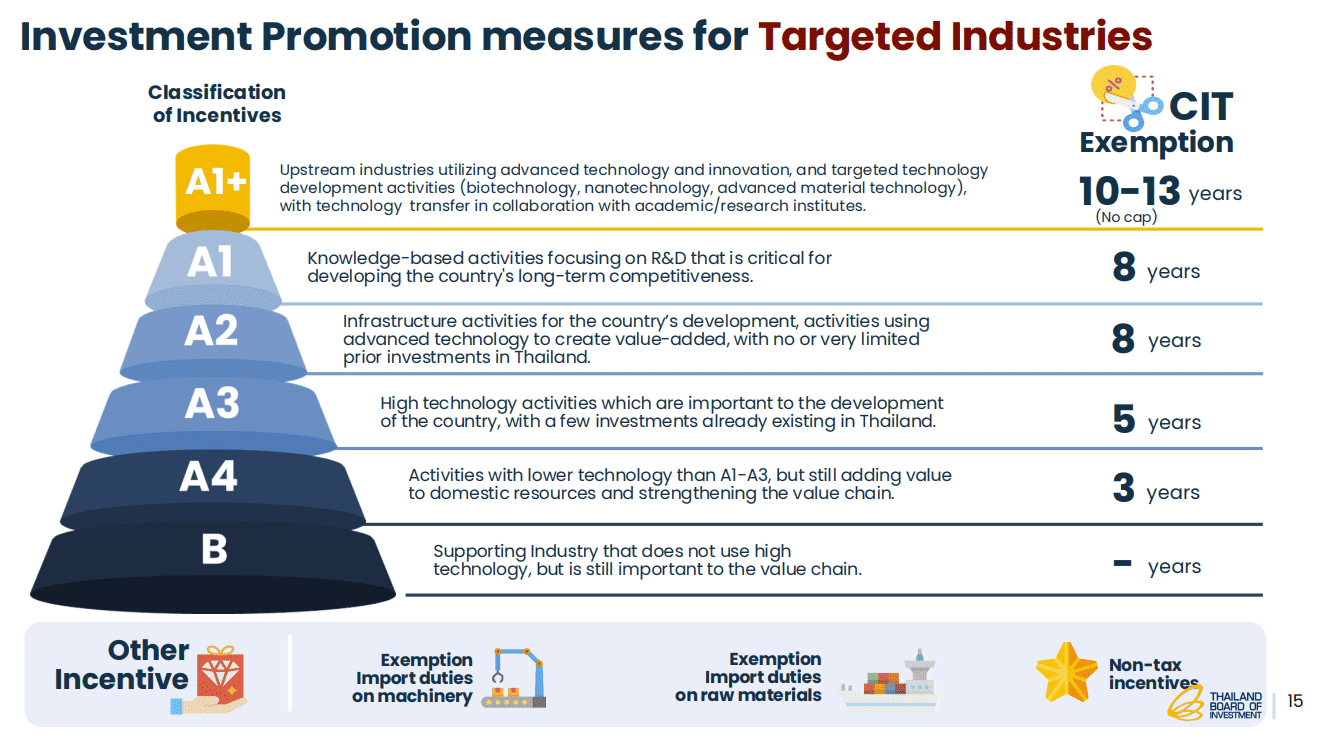
Investment promotion for tech company in Thailand (Source: BOI)
SaaS companies in particular benefit from Thailand's geographic position. You're in the same timezone as Singapore, within two hours of six major Asian markets, and operating in a country with over 52 million internet users.
The Bangkok tech scene, centered around Sukhumvit, Ari, and the Ekkamai corridor, has produced regional SaaS players like Builk (construction tech), Pomelo (e-commerce), and Omise (fintech, now Synqa).
That is why, If you're building a SaaS product for the Southeast Asian market, Thailand gives you cost advantages, government support, and a talent pool that Singapore simply can't match at this price point.
2. Goverment-backed support you may not know
Reading about BOI incentives is one thing. Knowing where to physically walk in, who to talk to, and what programs are open to you right now is another.
Thailand has two government-linked institutions that tech and SaaS founders, both local and foreign can tap into immediately. Most founders don't know they exist. The ones who do have a genuine head start.
In this article, we introduce 2 goverment-backed support you should know: True Digital Park and Software Park Thailand.
2.1. True Digital Park (TDPK)

True Digital Park is Southeast Asia's tech and startup hub, located in the heart of Bangkok's South Sukhumvit CyberTech District.
Truedigitalpark It's not just a co-working space. It's a government-aligned ecosystem that actively helps founders cut through the bureaucracy of setting up in Thailand.
In March 2025, True Digital Park formally joined forces with the Board of Investment of Thailand (BOI), becoming an officially appointed BOI Certified Agent authorized to assist foreign nationals in applying for Long-Term Resident Visas and providing comprehensive market-entry support.
2.2. Software Park Thailand (SWPark)
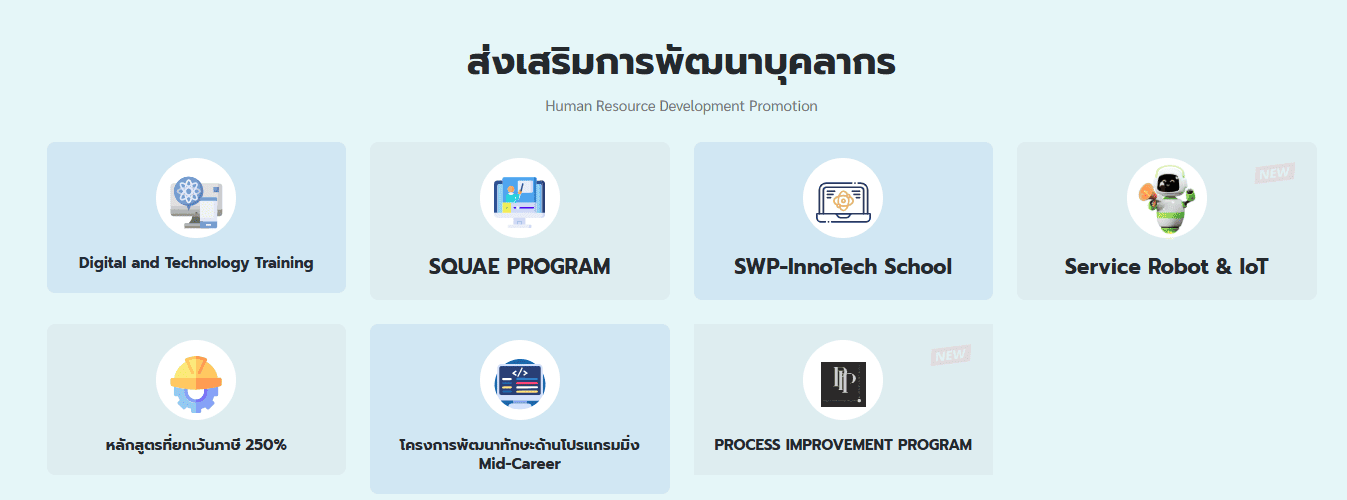
Where TDPK focuses on the startup ecosystem, Software Park Thailand (under NECTEC/NSTDA, the National Science and Technology Development Agency) is the government body specifically built to develop Thailand's software and digital services industry.
It's less well-known internationally. But for founders building software products — especially those who want to hire Thai developers, get CMMI certification, or access domestic funding programs.
What SWPark offers tech and SaaS companies:
- Talent development: SWPark runs continuous upskilling and reskilling programs for software developers and digital professionals — covering AI, IoT, automation, and software quality engineering. If you're building a local tech team, SWPark is actively producing the talent you'll hire.
- CMMI certification support: The CMMI program provides funded support for software companies seeking international process certification — a meaningful credential if you're selling B2B SaaS to enterprise clients in regulated industries.
- Process Improvement Program: Structured support to help software businesses improve their development workflows — useful for SaaS founders who want to scale their engineering team without losing quality.
3. What legal structure is right for your Thai tech &SaaS company?
Now that you understand why Thailand makes sense for tech and SaaS founders, let's get into the part that actually determines whether your setup works: structure.
This is where most founders get stuck, and where getting it wrong costs real money and months of fixing.
Thailand offers several legal entity types. But for tech and SaaS companies, two approaches dominate: Thai Private Limited Company and the BOI-Promoted Company, and a regional operating headquarter (bonus insight from our team).
We'll walk through both, explain exactly who each one is for, and show you how to choose.
Want to go deep on foreign ownership specifically? We cover the full picture in our in-depth guide: How to own 100% of a Thai company as a foreigner.
Here are some standard approaches you should know:
| Structure | Foreign Ownership | Tax Rate | Best For |
| Thai Private Limited (standard) | Up to 49% | 20% CIT | Small local teams |
| Foreign Business License (FBL) | Up to 100% | 20% CIT | Specific restricted sectors |
| BOI-Promoted Company | Up to 100% | 0–20% CIT | Tech, SaaS, R&D |
| SMART Visa (individual) | N/A | Personal income tax | Solo founder /employee |
3.1. Option 1: Thai Private Limited Company
This is the most common structure for small businesses.
The catch? Under the Foreign Business Act (FBA), most digital services fall under List 33, meaning foreign founders can own a maximum of 49% without additional licenses.
For a SaaS product where you need full control of IP and decision-making, this is often a dealbreaker. Unless you structure it correctly with a BOI application layered on top.
3.2. Option 2: BOI-Promoted Company (Recommended for SaaS)
The Board of Investment of Thailand (BOI) is the government agency that grants foreign founders the ability to own 100% of a Thai company in promoted sectors — including software, digital platforms, and R&D.
For most tech and SaaS foreign founders, BOI promotion is the path you can choose.
BOI-promoted tech companies get a package that's hard to find anywhere in the region:
- 100% foreign ownership (bypasses the Foreign Business Act);
- 0% corporate income tax for 5 to 13 years depending on activity type;
- Exemption from import duties on machinery and raw materials;
- Land ownership rights (normally restricted for foreigners);
- Fast-track work permits and visas for foreign employees.
3.3. Option 3: Regional Operating Headquarters (Bonus from our experts)
If you're building a product that serves multiple Southeast Asian markets from Thailand, a Regional Operating Headquarters structure gives you tax benefits on royalty income, dividends, and service fees from regional subsidiaries.
Most SaaS founders who successfully set up and manage their operations in Asia often choose to open a regional operating headquarters in Singapore, and Hong Kong managing their local teams in other countries such as Thailand, Vietnam, Indonesia, Phillipines, and more
If you need support, contact our experts today to discover how you can set up a tech&SaaS company the right way using ROH.
4. How to register your tech&Saas company in Thailand
Once you decide on your company structure, it's time to register your company with the Thai authorities.
The process has six steps. On paper, it looks straightforward. In practice, every step has small details that can delay your timeline by days or weeks if you're not familiar with how Thai government offices operate.
This is where having experienced local support of our expert team makes a real difference.
GLAC has helped founders complete this entire process, from name reservation to bank account, for over 10 years. If this is your first time incorporating your company and you are not sure the right way to build a sustainable business, talk to our team and we'll handle every step for you.
You submit 3 name options to the Department of Business Development (DBD). Names are approved or rejected within 1–3 business days.
Key rules to know: no names identical or similar to existing registered companies, and English names require an approved Thai translation.
Where founders get tripped up: Choosing names that are too generic or that unintentionally mirror existing Thai companies. GLAC's team pre-screens your options against the DBD database before submission so you don't waste days on a rejection.
Thailand's equivalent of Articles of Incorporation. It must include your company name and registered address, business objectives, share capital structure, and a list of at least 3 promoters.
A Thai lawyer drafts and files this with the DBD. The language, formatting, and business objective descriptions must follow specific DBD standards — vague or overly broad objectives get flagged.
Our legal team drafts MOAs specifically structured for tech and SaaS businesses. We know which business objective language the DBD accepts for software companies, and which phrasing triggers follow-up questions.
All promoters must convene — in person or via proxy — to formally approve the MOA, appoint directors, and authorize share allocation.
For foreign founders who aren't yet in Thailand, this step requires properly notarized proxy documentation. Getting this wrong is one of the most common causes of registration delays.
We prepare all proxy documents, handle notarization coordination, and can act as your authorized representative in Thailand if needed.
You file the full registration package with the DBD. Required documents include the completed MOA, shareholder and director list, statutory meeting minutes, registered capital evidence, and director identification documents.
If every document is clean and complete, the DBD can register your company in 1 business day. They now offer same-day registration at their Bangkok office.
We compile and verify every document before submission. After 10 years of DBD filings, we know exactly what reviewers look for — and we catch errors before they become rejections.
Within 60 days of generating revenue, you must register for Corporate Income Tax with the Revenue Department, and for VAT if your annual revenue exceeds THB 1.8 million (~$50,000 USD).
SaaS companies serving overseas customers need particular attention here. Thailand's VAT rules on cross-border digital services changed in 2021. Revenue from foreign customers may be zero-rated if your invoicing and service delivery are structured correctly — but this requires getting the setup right from day one.
Our tax team handles both CIT and VAT registration, and structures your SaaS billing model to be compliant and tax-efficient from the start. We work with you proactively — not reactively after a problem surfaces.
This step happens after your company registration certificate is in hand. See the banking section below for the full breakdown of which banks work best for tech startups and how to receive SaaS revenue from overseas.
We have established relationships with Kasikorn Bank, Bangkok Bank, and SCB and esteemed banks in Bangkok.
We prepare your bank application package and can accompany you to the appointment, significantly reducing the back-and-forth that foreign founders typically face.
5. How can we help you go from idea to operating in Thailand?
Here's the reality most founders face.
You've read the guides. You understand the structure. You know BOI is the right path.
But then you sit down to actually do it, and you're staring at Thai government portals, legal documents in a language you don't read, bank account requirements that keep changing, and a visa process where one wrong document means starting over.
This is exactly where founders get stuck. Not because the process is impossible. Because it wasn't designed for someone doing it for the first time, from the outside, while also trying to build a product.
That's the pain our experts at GLAC was built to solve.
We've spent 10 years helping hundreds of founders, international teams from the US, Europe, Australia, and across Asia, set up and operate tech and SaaS companies in Thailand.
We don't just advise. We handle it.
- Assess your revenue model, team structure, and goals to recommend the right legal structure, ownership approach
- Pre-screen your name options against the DBD database and submit on your behalf
- Provide or recommend a legitimate, BOI-eligible address so you're compliant from day one
- Handle all DBD filings, statutory meeting documentation, and director ID submissions from start to finish
- Prepare your full bank application package, leverage relationships with KBank, Bangkok Bank, and SCB, and accompany you from start to finish,
- Provide ongoing monthly/yearly tax accounting services, and annual audits so you stay compliant without thinking about it.
6. FAQs about Tech & SaaS Company setup in Thailand
From decision to fully operational, budget 8–14 weeks if you're applying for BOI, or 4–6 weeks for a standard registration without BOI. The BOI certificate is typically the longest step at 4–8 weeks.
However, based on our experience, the actual timeline is often significantly longer, typically ranging from 4 to 12 months,as BOI authorities tend to scrutinize each application in detail. Your best approach is to preapare everything as much as possible to shorten the screening time.
Yes, through BOI promotion for qualifying tech and software activities, or via a Foreign Business License for certain sectors. Without these, foreigners are generally capped at 49% ownership under the Foreign Business Act.
Yes, for several reasons: BOI grants 8+ years of 0% corporate tax for software development; Bangkok has a growing mid-tier developer talent pool at competitive salaries; and Thailand's location makes it a practical base for serving Southeast Asian B2B customers.
The main challenge is banking setup and government administration communication, which takes longer than Singapore or Hong Kong.
With over a decade of experience serving as a trusted partner to more than 750 business owners seeking professional development and breakthroughs in the international market, we are an expert strategic corporate service provider helping you incorporate and operate successfully in 10 different countries
Our areas of expertise include:
- Strategic Consulting and Company formation in over 10 different countries worldwide such as Singapore, Hong Kong, the U.S., Australia, Thailand, Malaysia, and offshore destinations like BVI, Belize, Seychelles, and more.
- Account opening for personal and corporate bank accounts, as well as setting up PayPal and Stripe gateqays in countries like Singapore, Hong Kong, and the U.S..
- Tax Consulting and Preparation for SFRS IFRS financial reports, corporate income tax returns, VAT/GST (Value Added Tax/Goods and Services Tax), and more.
- Opreation support:
- Registered adress;
- Foreign consular legalization;
- Trademark and patent protection registration in Singapore and the US;
- Employment Pass application in Singapore and Hong Kong;
- Website design, international SIM number provision;
- DUNS registration.
With over 10 years of experience and a team of experts with 5 to 25 years of experience (international standard certifications) as well as direct partnerships with institutions such as OCBC, UOB, DBS, PayPal, and Stripe, we are proud to offer professional, legal, transparent, sustainable services with no hidden costs.


Global Link Asia Consulting Pte. Ltd. is pleased to announce the publication of the above insightful and informative article on our official website, Global Link Asia Consulting on 22nd April 2026. The copyright for this article is exclusively held by Global Link Asia Consulting Pte. Ltd. Any unauthorized reproduction or distribution of this content without our express written permission is strictly prohibited. We value the protection of our intellectual property and appreciate your cooperation in adhering to these guidelines. Thank you for your continued support of Global Link Asia Consulting Pte. Ltd.
The content in this article is provided by Global Link Asia Consulting for general informational purposes only. It is intended as a helpful reference and should not be considered legal, tax, accounting, banking, or other professional advice. Because laws and regulations can change, and every situation is different, we recommend that individuals and businesses seek independent professional advice before making any important decisions. Global Link Asia Consulting is not responsible for any loss or damage that may result from relying on the information in this article without obtaining appropriate professional advice.

 470 North Bridge Road, #05-12, Bugis Cube, Singapore (188735).
 Unit 308, 3/F, Chevalier House, 45-51 Chatham Road South, Tsim Sha Tsui, Hong Kong.
 90/14-17 Sathorn Thani Building 1, 8th Floor, North Sathorn Road, Silom, Bangrak, Bangkok 10500.
 12th, Felix Alley Building, 151/1-2 Nguyen Van Troi, Phu Nhuan District, Ho Chi Minh City, Vietnam.