+65 83551210
If you have a Thai partner you trust 100% to be your local shareholder, that’s great.
If you don’t, that’s okay too. There are still legal ways for foreigners to own 100% of a Thai company.
However, it’s not as simple as just registering a company. There are strict laws, conditions, and industry restrictions you must follow.
Done right, you get:
- Full ownership control;
- Tax incentives and privileges;
- Access to a fast-growing ASEAN market;
- A compliant, scalable business structure.
So how do you legally own 100%?
Which structure is right for you? Can you avoid the common pitfalls?
And the biggest question, which option gives you the most flexibility?
You’ll find the answers below, from our company formation expert, specializing in the Thai market.
But first, here are the 5 most common ways foreigners can own 100% in Thailand and what the Foreign Business Act actually is.
| Option | Best for | Key notes |
| FBL (Foreign Business License) | All businesses that require under the Foreign Business Act. | Require case-by-case approval; Be subject to Foreign Business Act restrictions. |
| BOI (Board of Investment) | Promoted industries (tech, manufacturing, etc.). | Offers amazing incentives; Allow 100% foreign ownership. |
| Amity Treaty | US citizens. | Special privileges under treaty; Majority ownership allowed in many sectors. |
| Representative Office | Companies doing market research and liaison activities. | Cannot generate revenue; Limited activities. |
| Branch Office | Existing foreign companies wanting to expand overseas under the same name. | Can generate income; Must comply with Thai regulations. |
1. News for 100% foreign ownership in Thailand (2026 updated)
As of 2026, there are specific business activities where full foreign ownership is already allowed by default, but only if your business is structured carefully and stays within the allowed activities.
Here are the key ones:
| Industries | Best for |
| Manufacturing | Manufacturing remains one of the most foreign-friendly sectors in Thailand. To qualify, your business income must come from manufacturing your own products and exporting those products. If you add services like: Maintenance, repair, consulting. You may trigger restricted activity rules and need an FBL or BOI promotion. |
Trading Read our guide to learn more about opening a trading company in Thailand | If your company purchases goods in Thailand and exports them overseas only, then it is generally considered a non-restricted activity. However, the moment you sell within Thailand, you may fall into restricted trading/service categories. |
Tech businesses Read our guide to learn more about opening a tech company in Thailand | This is one of the most important updates. The Department of Business Development (DBD) has recently removed certain specialized tech activities from the restricted list. This means foreigners can now own 100% of these businesses without needing an FBL. Eligible activities include:
This is a major shift aimed at attracting high-value, innovation-driven businesses. To learn more how you can open a Tech&SaaS company in Thailand, read our article: How to open a Tech & SaaS company in Thailand: A complete guide. |
2. What is Foreign Business Act of Thailand?
The Foreign Business Act (FBA) is the primary law governing how foreign individuals and companies can operate businesses in Thailand.
Its main purpose is to regulate foreign participation in certain industries and protect local Thai businesses.
Under this Act:
- Foreigners are restricted from operating specific business activities unless permission is granted;
- Businesses are categorized into three lists (List One, Two, and Three) based on restriction levels;
- Foreign companies, foreigners must comply with licensing requirements or obtain approval from relevant authorities.
Specifically, the Act divides restricted activities into three categories:
List One: Businesses that foreigners are not permitted to engage in for special reasons
List Two: Businesses concerning national security or safety that could have an adverse effect on art and culture, customs, or native manufacture/handicrafts, or with an impact on natural resources and the environment.
Under List Two, you are allowed only if all conditions are met
- At least 40% of shares are held by Thai nationals;
- At least two-fifths of the directors are Thai;
- A Foreign Business License (FBL) or a Foreign Business Certificate (FBC) is obtained.
List Three: Businesses in which Thais are not ready to compete in undertakings with foreigners.
Under List Three, you may have 100% foreign ownership under some conditions, which are not as strict as those for List Two.
2.1. Who does this act apply to?
The Act applies to the following:
- A natural person who is not Thai;
- A juristic person not registered in Thailand;
- A juristic person registered in Thailand, of which foreigners own at least 50% of shares.
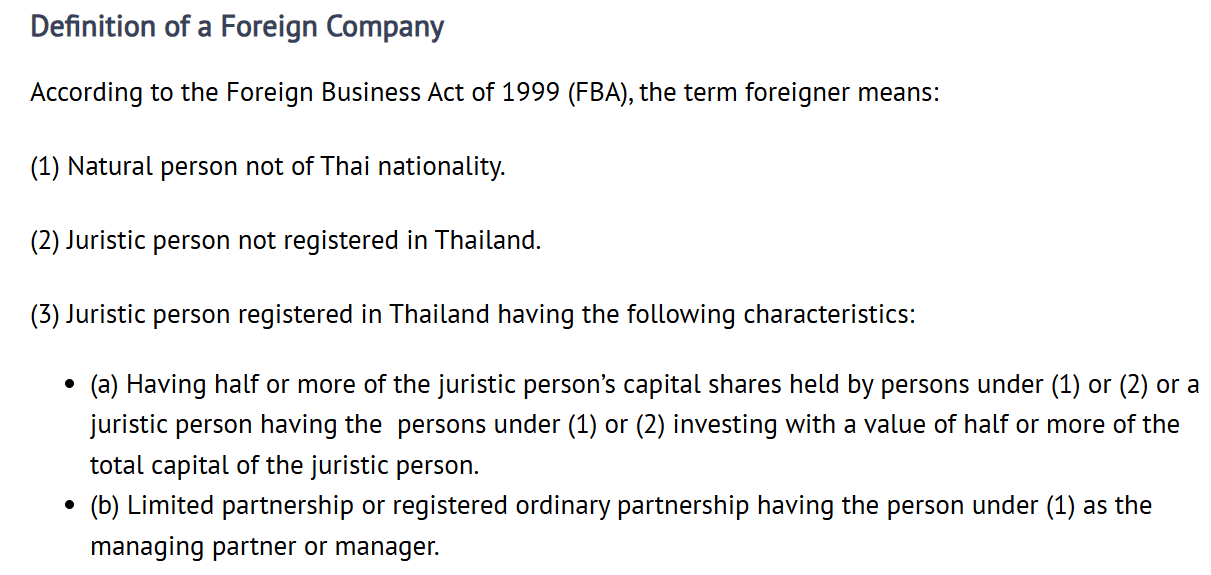
- Definition of foreign company under the Foreign Business Act of 1999 (FBA)
Due to the Foreign Business Act, foreigners can not own 100% of a company in Thailand for many business activities. To achieve full foreign ownership, you must satisfy specific legal requirements and rely on one of the five approved pathways explained in this guide.
3. Foreign business license (FBL)
Best for foreign companies that want to legally operate restricted businesses in Thailand.
Key note: Require goverment approval on a case-by-case basis.
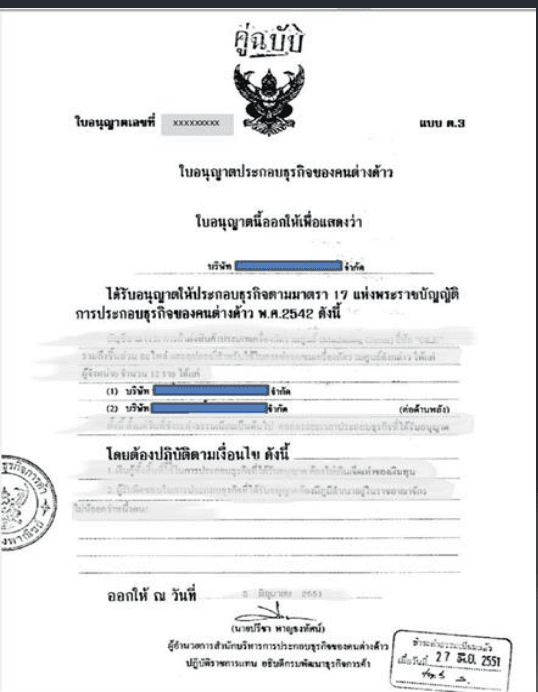
Example of Foreign Business license (Source: Department of Business Development )
If your business falls under restricted activities (especially List Three), the Foreign Business License (FBL) is the most direct way to operate legally in Thailand as a foreign-owned company.
3.1. What you should know about FBL?
To apply for an FBL, a foreign applicant must generally meet these requirements (including but not limited to):
- Be at least 20 years old;
- Not be bankrupt;
- Not be declared incompetent or quasi-incompetent;
- Have no criminal record from court judgment;
- A solid business plan;
- Required large capital investment;
- Supporting documents to justify your application.
In addition, getting an FBL doesn’t mean you’re done.
Depending on your business, you may also need additional licenses, for example:
- Opening restaurants requires you to have food and operating licenses;
- Running pharmaceutical businesses requires you to gain regulatory approvals;
- Large or high-impact factories must obtain a factory license before operating.
To learn more about whether your business requires a specific license, you can refer to this comprehensive resource from the OSOS (One Start One Stop Investment Center), under the Department of Business Development (DBD): Business license application.
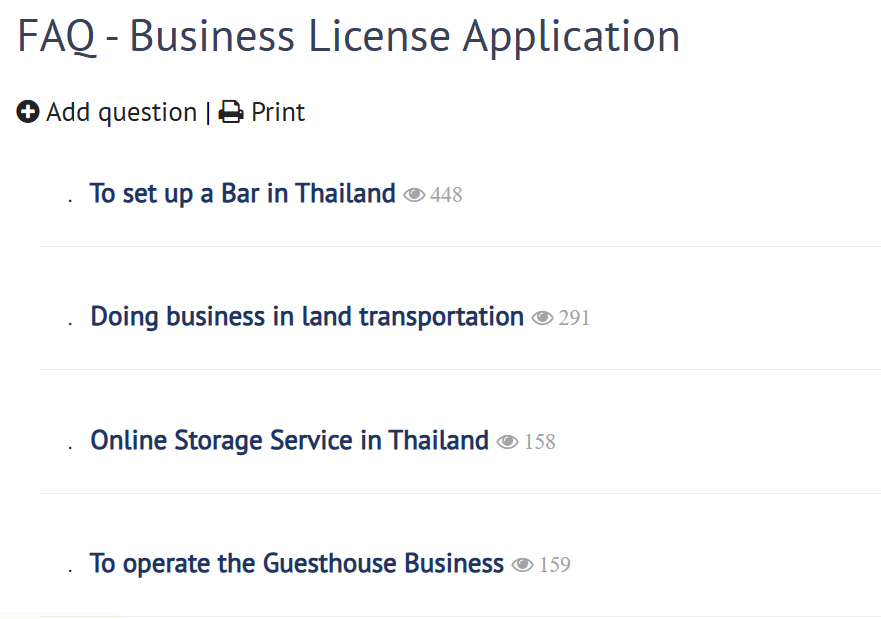
Business license application for each business actitivies
3.2. Downsides of applying for a FBL
The main downside our experts notice when it comes to the FBL approval is the time it takes to approve or reject the application.
- The process is lengthy and complex;
- It typically takes at least 4 months (or longer) to receive a decision. Some even wait for 1 year to finally receive a rejection letter;
- Approval is not guaranteed (Must be checked and approved by the DBD);
- Requires strong justification and preparation.
If you goal is to operate legally in a restricted sector without giving up control, the FBL remains one of the most reliable pathways.
4. BOI promotion
Best for promoted industries, targeted services under the new promotion, invesment scheme of Thailand

Thailand Board of Invesment
If you’re serious about building a long-term business in Thailand, BOI promotion is one of the most powerful options available. You can check the offical website of BOI Thailand to learn more
4.1. What you should know about BOI?
Besides FBL, your foreign company can aslo get BOI promotion. If it is BOI-apporved, you can obtain a Foreign Business Certificate (FBC). This allows you to operate restricted activities as a 100% foreign-owned company.
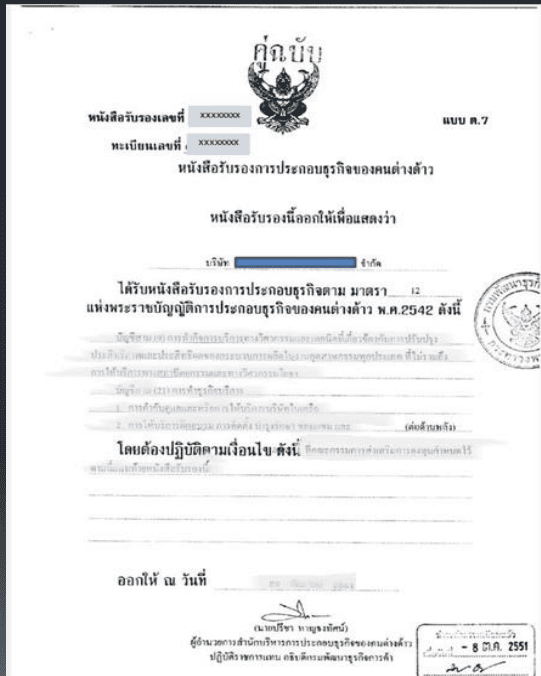
Example of Foreign Business certificate (Source: Department of Business Development)
BOI isn’t just about ownership. It’s designed to attract serious foreign investment, so the incentives are strong:
- 100% foreign ownership allowed;
- Corporate income tax exemptions (for a fixed period, depending on project);
- No foreign employee quota (easier work permits);
- Land ownership rights (rare for foreigners in Thailand);
BOI doesn’t approve everything. It focuses on industries that add value to Thailand’s economy, such as:
- Agriculture and agro-processing;
- Manufacturing (light industry, machinery, electronics);
- Chemicals, plastics, and materials;
- Technology and innovation;
- Certain service and public utility sectors.
If your business is of low value or purely local service-based, BOI approval is less likely. If your business belongs to the 12 targeted industries and 5 strategic sectors, your approval is highly likely to be passed.
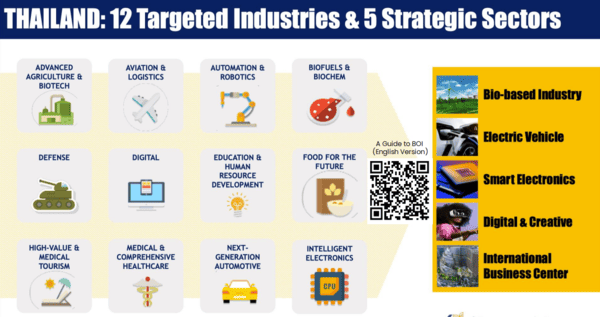
Promoted industries and sectors of Thailand (Source: Dr. Sawitree Suwannasang Nordic Director, Thailand Board of Investment)
4.2. Downsides of getting BOI you should know in advance
There are some barriers to getting BOI acceptance letter, you should take into consideration:
- The process is time-consuming and can take several months;
- It is expensive, especially when factoring in setup, compliance, and advisory costs;
- Approval standards are high, your company needs to be well-prepared and financially strong from the start;
- BOI acceptance letter typically requires significant capital investment, depending on the project (BOI requires a certain amount which will be announced upon approval of the promotion).
This is not a beginner-friendly route or for small, low-budget startups. But if you have a serious business plan and resources to back it, BOI is still one of the most powerful ways to enter and scale in Thailand.
5. Treaty of Amity
Best for US entrepreneurs who want 100% ownership without FBL or BOI.
If your company is majority-owned by US citizens, you can apply under the Treaty of Amity.
It’s one of the simplest legal shortcuts to full ownership in Thailand.
5.1. What you should know about Treaty of Amity?
To be eligible for the treaty of Amity, your company must:
- Be majority-owned by US citizens (at least 51%);
- Have at least 50% of directors as US citizens.
Once approved, your company is treated almost like a Thai company in many business activities.
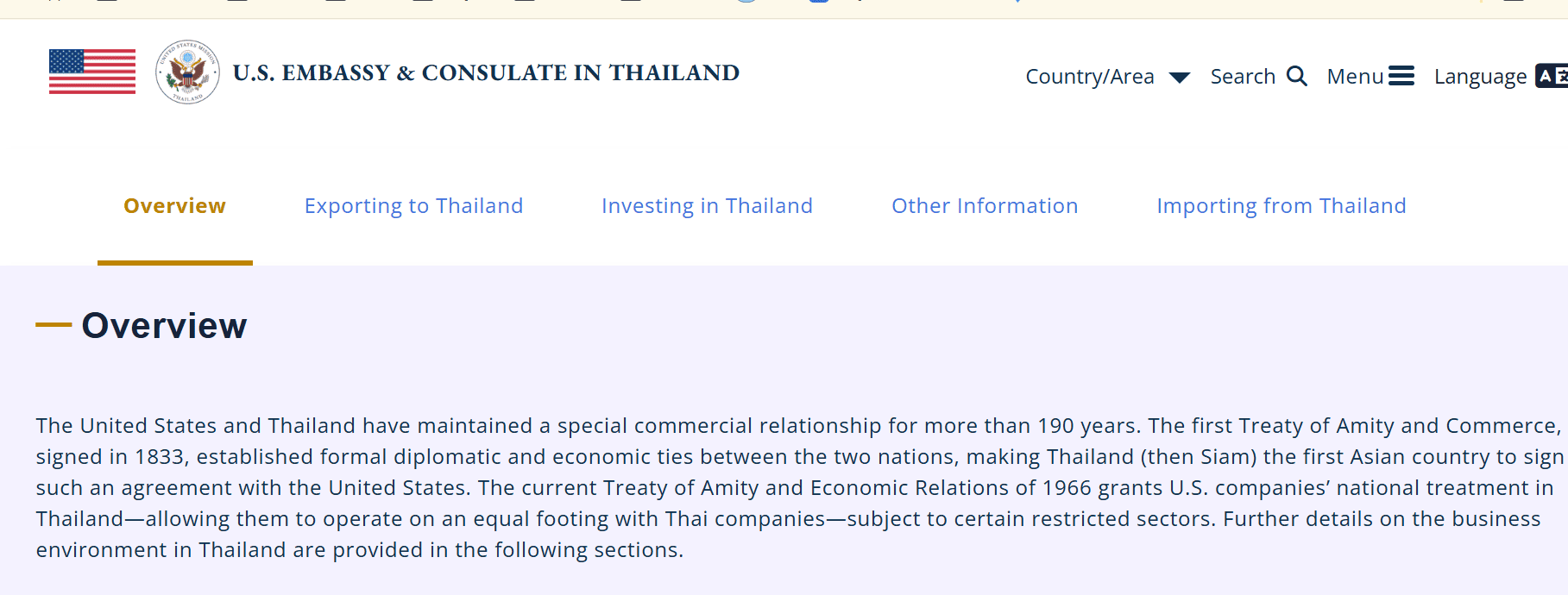
Notification of Treaty of Amity on U.S Embassy & Consultant in Thailand
5.2. Downsides of the Treaty of Amity
The Treaty of Amity does not give unlimited access. You are still restricted from certain sectors, including: communications, transportation, banking (deposit-taking activities), fiduciary services, land ownership and natural resource exploitation, domestic trade in local agricultural products.
6. Representative Office
Best for foreign companies that want a presence in Thailand without doing business.
A Representative Office is one of the simplest ways to establish a presence in Thailand—without dealing with FBL or ownership restrictions. But here’s the key thing you must remember: You cannot generate income in Thailand.
6.1. What you should know about representative offices?
A Representative Office is limited to non-commercial activities only.
That includes:
- Training and development;
- Technical support to head office or partners;
- Financial and operational coordination;
- Marketing and sales planning (but not execution);
- Product development;
- Research and development.
You’ll also need to meet capital requirements, a minimum of THB 2 million which can be paid in installments:
- 25% within 3 months;
- 25% within 1 year;
- 25% within year 2;
- 25% within year 3.
6.2. Downsides of a Representative Office
While this is a valid entry option, it’s not ideal for the majority of businesses. This is not for companies looking to do business, only to support or explore the market or build relationships.
- Cannot earn revenue in Thailand;
- Cannot issue invoices or sign revenue-generating contracts;
- Limited scope of activities;
- Only really suitable for large corporations willing to invest in market research and partner relationship building;
- Not practical for SMEs or businesses that need quick revenue generation.
7. Branch Office
Best for foreign companies that want to do business directly in Thailand using the same brand name.
7.1. What you should know abour branch office?
Unlike a Representative Office, a Branch Office gives you the ability to actually run a business and generate revenue in Thailand.
That means:
- You can earn income locally;
- You can enter into contracts, issue invoices, and operate commercially;
- You can carry out full business activities on behalf of your head office.
- But here’s where it gets important: Whether or not you can operate freely depends on your business activity.
If your activity falls under restricted sectors (which many service businesses do). You’ll still need to apply for a Foreign Business License (FBL).
If your activity is not restricted. You can operate with a Commercial Registration Certificate from the Ministry of Commerce,
Another key point most people overlook: a Branch Office is not a separate legal entity.
That means:
- The head office is fully responsible for all liabilities;
- Any legal, financial, or operational risks in Thailand go directly back to the parent company.
7.2. Downsides of a branch office
While this is a valid entry option, it’s not ideal for the majority of businesses.
- May still require an FBL (same level of complexity as setting up a company);
- The minimum capital requirement is relatively high;
- THB 3 million for restricted businesses;
- THB 2 million for non-restricted businesses.
This means you need to commit a significant amount of capital upfront, which can be a barrier for many businesses.
- Not a beginner-friendly option, especially for small or newly established foreign companies with limited budgets;
- The head office bears full liability for all operations in Thailand;
- Registration and compliance can be time-consuming and complex.
While a Branch Office gives you full operational capability, it’s generally more suitable for established companies with strong financial capacity, rather than SMEs just entering the market.
8. Ready to open your company in Thailand?
Getting 100% foreign ownership in Thailand is absolutely possible. But it’s important to set the right expectations.
These structures (FBL, BOI, Treaty of Amity, or non-restricted sectors) enable you to operate legally. They don’t automatically make your business easy to set up.
To succeed, you still need to:
- Choose the right structure from the start;
- Align your business activity with Thai regulations;
- Prepare proper documentation, capital, and strategy.
The difference between a smooth setup and months of delays often comes down to how well you plan upfront. If you’re serious about entering Thailand, we can support you
- Set up your company in a way that is fast, compliant, and aligned with Thai regulations;
- Select the best structure based on your business model;
- Secure the right licenses with full support for FBL, BOI, and other required permits;
- Handle tax and accounting from initial setup to ongoing compliance;
- Open corporate bank accounts both locally and internationally;
- Build a scalable financial system using QuickBooks (QBO) and structured reporting;
- Apply AI tools to streamline operations, reporting, and decision-making;
- Support your growth from market entry to long-term expansion.
9. FAQs about Thailand company formation
Yes, but only in certain cases. Full foreign ownership is allowed for non-restricted activities (like manufacturing or export), or if you obtain approval through structures such as BOI promotion, Foreign Business License (FBL), or the Treaty of Amity (for US citizens).
Company registration itself can take a few days to 1–2 weeks. However, if you require licenses like an FBL or BOI approval, the process can take 2 to 4 months or longer depending on complexity.
Not necessarily. You can start the process remotely, but certain steps (like opening a bank account or visa/work permit setup) may require your presence in Thailand.
The main tax is Corporate Income Tax (CIT) at 20%. You may also need to register for VAT (7%) if your revenue exceeds the threshold, along with withholding tax and other compliance requirements depending on your activities.
With over a decade of experience serving as a trusted partner to more than 750 business owners seeking professional development and breakthroughs in the international market, we are an expert strategic corporate service provider helping you incorporate and operate successfully in 10 different countries
Our areas of expertise include:
- Strategic Consulting and Company formation in over 10 different countries worldwide such as Singapore, Hong Kong, the U.S., Australia, Thailand, Malaysia, and offshore destinations like BVI, Belize, Seychelles, and more.
- Account opening for personal and corporate bank accounts, as well as setting up PayPal and Stripe gateqays in countries like Singapore, Hong Kong, and the U.S..
- Tax Consulting and Preparation for SFRS IFRS financial reports, corporate income tax returns, VAT/GST (Value Added Tax/Goods and Services Tax), and more.
- Opreation support:
- Registered adress;
- Foreign consular legalization;
- Trademark and patent protection registration in Singapore and the US;
- Employment Pass application in Singapore and Hong Kong;
- Website design, international SIM number provision;
- DUNS registration.
With over 10 years of experience and a team of experts with 5 to 25 years of experience (international standard certifications) as well as direct partnerships with institutions such as OCBC, UOB, DBS, PayPal, and Stripe, we are proud to offer professional, legal, transparent, sustainable services with no hidden costs.


Global Link Asia Consulting Pte. Ltd. is pleased to announce the publication of the above insightful and informative article on our official website, Global Link Asia Consulting on 26th March 2026. The copyright for this article is exclusively held by Global Link Asia Consulting Pte. Ltd. Any unauthorized reproduction or distribution of this content without our express written permission is strictly prohibited. We value the protection of our intellectual property and appreciate your cooperation in adhering to these guidelines. Thank you for your continued support of Global Link Asia Consulting Pte. Ltd.
The content in this article is provided by Global Link Asia Consulting for general informational purposes only. It is intended as a helpful reference and should not be considered legal, tax, accounting, banking, or other professional advice. Because laws and regulations can change, and every situation is different, we recommend that individuals and businesses seek independent professional advice before making any important decisions. Global Link Asia Consulting is not responsible for any loss or damage that may result from relying on the information in this article without obtaining appropriate professional advice.
 470 North Bridge Road, #05-12, Bugis Cube, Singapore (188735).
 Unit 308, 3/F, Chevalier House, 45-51 Chatham Road South, Tsim Sha Tsui, Hong Kong.
 90/14-17 Sathorn Thani Building 1, 8th Floor, North Sathorn Road, Silom, Bangrak, Bangkok 10500.
 12th, Felix Alley Building, 151/1-2 Nguyen Van Troi, Phu Nhuan District, Ho Chi Minh City, Vietnam.