+65 83551210

The company has been incorporated in Hong Kong, and you have the Certificate of Incorporation (CI) and the Business Registration Certificate (BRC). With these two documents in hand, you visit the bank to open a corporate bank account.
However, the bank asks you to provide additional information about your ownership structure, source of funds, and evidence of actual business activities. At this point, you realise that the two incorporation certificates alone are not enough to complete the account opening application.
"I already have my CI and BRC – why is the bank still asking for so many documents?"
For businesses raising capital, hiring employees, or conducting cross-border transactions, delays in opening a corporate bank account can directly affect business operations. These delays can make it difficult to process payroll, pay suppliers, and fulfil existing contractual obligations.
With more than 10 years of experience helping companies open bank accounts across 10+ countries, our banking experts have found that complete documentation, consistent information, and transparency are key factors in helping applications proceed smoothly.
In this guide, we'll walk you through the documents to prepare and the corporate bank account opening process in Hong Kong, including:
- Why you should prepare all required documents before submitting your account opening application.
- The list of documents banks require when opening a corporate account.
- The stages banks follow to review and conduct due diligence on your application.
- Traditional versus digital banks, their key features, and how to choose the right option for your business needs.
- The common reasons why applications are delayed or rejected.
Let's get into it.
1. Why you need to prepare your documents before applying?
Preparing all required documents before applying shortens the review time and reduces the risk of rejection.
Every bank in Hong Kong must conduct Customer Due Diligence (CDD) under the Anti-Money Laundering and Counter-Terrorist Financing Ordinance (Cap. 615).
That means the bank is legally required to verify your identity, who owns the company, and what the funds will be used for. Submitting a complete file up front helps you meet these checks in one go, instead of having the review paused for repeated requests for additional documents.
To show you why preparation pays off, our banking experts have outlined three key benefits below:
| Reason | What it does for your business |
| Shortens the review time | A complete file gives the bank the information it needs to verify the company's legal status, the identities of relevant parties, and its business activities without waiting for additional documents. This helps move the review forward faster. |
| Limits requests for additional documents | Hong Kong has no single standard document checklist for all banks. Each bank sets its own document requirements and acceptance criteria. Checking your target bank's requirements in advance helps avoid errors, repeated corrections, and re-submissions (HKMA). |
| Lowers the risk of rejection | The CDD process requires banks to verify the customer's identity, ownership structure, and purpose of opening the account. If your company cannot provide enough information for the bank to complete these checks, the application may be returned for additional documents or declined. |
2. The 5 document groups to prepare before opening a corporate account in Hong Kong
You need to prepare 5 groups of documents: the identity files for the people involved, the company's legal papers, the explanation of the account's purpose and activity, additional documents by company type and structure, and any industry-specific licences.
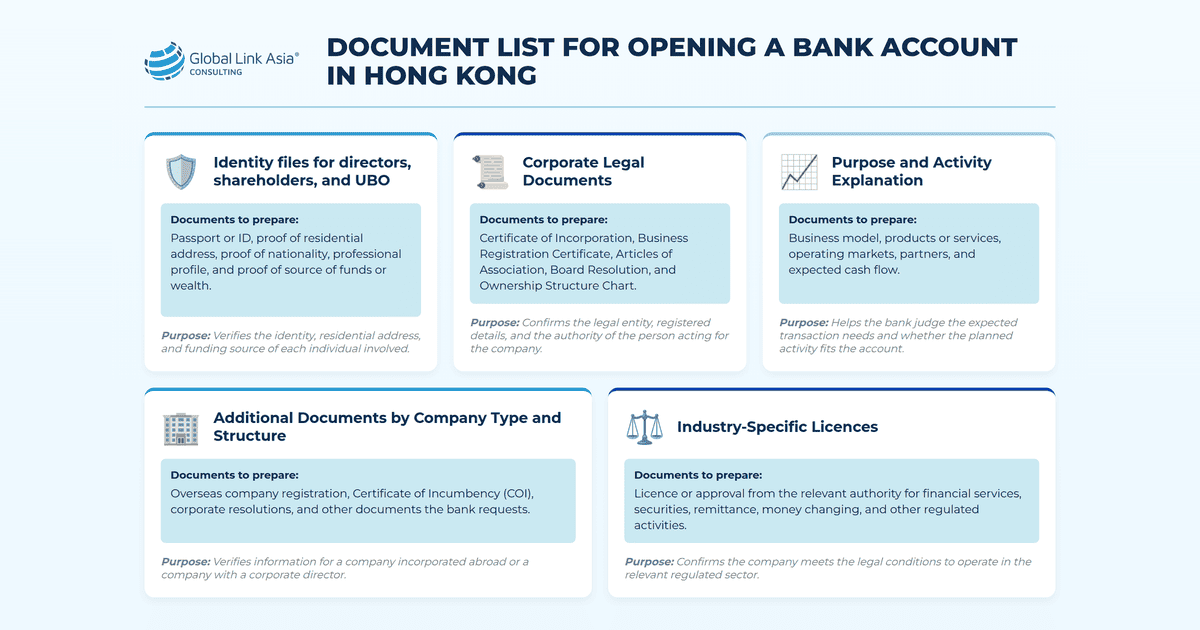
Documents Businesses Need to Prepare Before Opening a Bank Account in Hong Kong
Banks use these documents to verify legal status, identify the person who owns or controls the company, and assess the purpose of the account.
To help you spot the required files quickly, our international banking expert, Erik, mapped the 5 groups and what each one is used for when you open a corporate bank account in Hong Kong:
| Document group | What to prepare | What it's used for |
| Identity files for directors, shareholders, and UBO | Passport or ID, proof of residential address, proof of nationality, professional profile, and proof of source of funds or wealth | Verifies the identity, residential address, role, and funding source of each individual involved. |
| Corporate legal documents | Certificate of Incorporation, Business Registration Certificate, Articles of Association, Board Resolution, Ownership Structure Chart, and Register of Significant Control | Confirms the legal entity, registered details, ownership structure, and the authority of the person acting for the company. |
| Purpose and activity explanation | Purpose of the account, business model, products or services, operating markets, partners, and expected cash flow | Helps the bank judge the expected transaction needs and whether the planned activity fits the account. |
| Additional documents by company type and structure | Overseas company registration, Certificate of Incumbency (COI), corporate resolutions, and other documents the bank requests | Verifies information for a company incorporated abroad or a company with a corporate director. |
| Industry-specific licences | Licence or approval from the relevant authority for financial services, securities, remittance, money changing, and other regulated activities | Confirms the company meets the legal conditions to operate in the relevant regulated sector. |
We help you confirm which documents apply to your structure, complete them correctly, and review their completeness and consistency before you hand anything to the bank.
Banks use corporate legal documents to confirm the legal existence of the entity, check its registered details, and identify the individuals authorised to represent the company and carry out transactions.
To clarify the role of each document during the bank's review, our banking expert, Erik, has summarised the legal documents businesses need to prepare in the table below:
| Document | What it does in the review |
| Certificate of Incorporation (CI) | Confirms the company was legally established in Hong Kong. |
| Business Registration Certificate (BRC) | Provides the business registration details and registration number issued by the Inland Revenue Department (IRD). |
| Articles of Association (AoA) | Sets out the governance structure and the powers and responsibilities of each role. The bank uses it to verify the authority of the representative and the individuals authorised to open and manage the account. |
| Board Resolution (BR) | Records the decision to open a bank account and appoints the individuals authorised to manage it. Even a company with a single director needs a written resolution. The resolution must state the company name, bank name, and confirm the authority to open and manage the account. |
| Ownership Structure Chart | Shows the shareholders, ownership percentages, and the relationship between the company and its parent company or intermediate entities. This helps the bank identify the UBO and individuals who have control over the company. |
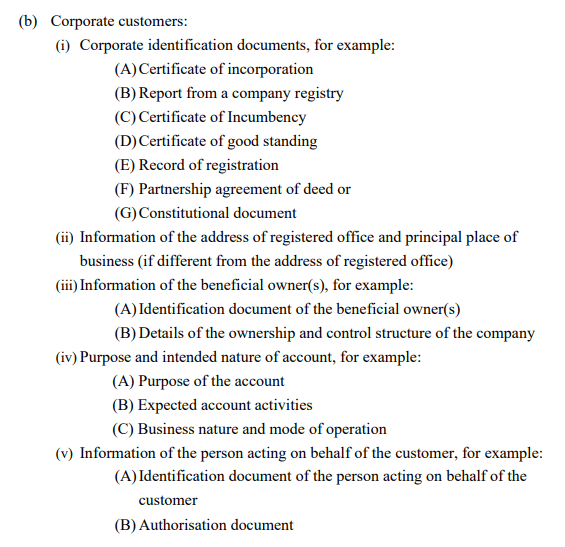
HKMA Notice on the Documents Banks May Request When Opening a Corporate Bank Account
One important distinction to understand: the CI and BRC are two completely different documents.
- The CI is issued by the Companies Registry and confirms that the company has been legally incorporated in Hong Kong.
- The BRC is issued by the Inland Revenue Department (IRD) for business operations in Hong Kong. This certificate has a specific validity period and expiry date. Therefore, you must submit both documents and ensure the BRC is still valid when you apply.
For a newly established company, the bank is essentially looking for an answer to one question:
Can you prove that the business is real and will generate actual transactions?
A company profile, a working website, draft contracts, and a brief explanation of the business model provide much stronger evidence of actual business activity than incorporation certificates alone.
Erik, International Bank Account Consultant, Global Link Asia Consulting
You need to describe the purpose of the account and the activity you plan to run through it. The bank uses this to understand your transaction needs and judge whether they fit your business. Prepare the following:
- Purpose of the account: state the intended use, such as receiving customer payments, paying suppliers, managing cash flow, or running international transactions;
- Expected activity through the account: describe the transaction types, expected values, and frequency, and name the relevant countries or markets;
- Sector and business method: present the products or services, the target customers, the operating markets, and how the business is delivered.
Keep the explanation consistent with your registration and business plan. If the account serves international transactions, spell out the parties involved, the relevant countries, and the purpose of each transfer, so it supports the bank's review.
Beyond the core legal documents, you need to identify and prepare the additional documents that fit your company's type and structure. The required documents for each case are:
- Hong Kong limited company: Prepare the Company Search Document and the resolution to open the bank account if the bank requires it. The CI and BRC are issued together at the time of incorporation;
- Overseas company: Prepare the business registration certificate or equivalent documents, the Certificate of Incumbency (COI), or other documents as required by the bank;
- Company with a corporate director: In addition to the applying company's documents, the bank may require a corporate resolution appointing the authorised representative to carry out the account opening procedures.
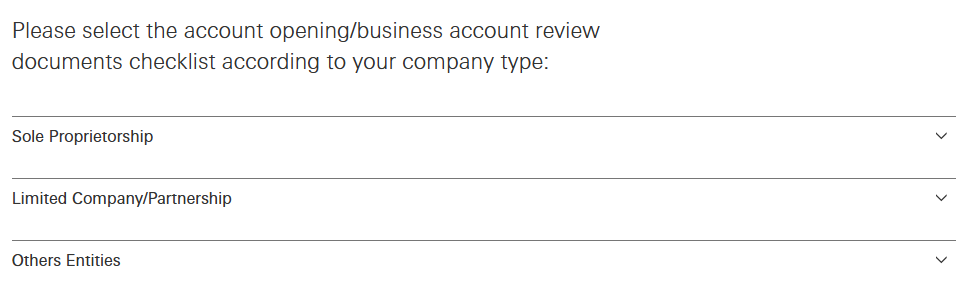
OCBC's guide to selecting the required documents for opening a bank account based on company type (Source: OCBC Bank)
A company operating in a regulated sector must provide the licence or approval issued by the competent authority. The bank will look at the registered business activity, operating model, and transaction scope to determine what additional documents it needs.
Based on our experience supporting international bank account applications, GLAC recommends preparing licences that match your actual business activities. A few cases to note:
- Financial services and securities: Provide a licence or registration with the Securities and Futures Commission (SFC) if the business activity falls under its supervision;
- Remittance and money changing: A company providing remittance or money-changing services must hold a Money Service Operator (MSO) licence, overseen by the Customs and Excise Department (C&ED);
- Import and export of controlled goods: A company trading strategic goods such as chemicals or dual-use equipment needs an import/export licence issued by the Trade and Industry Department (TID);
- Other regulated activities: Provide the business licence or approval that matches the company's field of operation.
You only need to notarise certain identity documents, such as the passport, CI, or COI. According to the HKMA's Anti-Money Laundering (AML) FAQ (2022), other due-diligence documents generally do not require notarisation.
To help you prepare the right documents from the start, our banking expert, Erik, has summarised the key HKMA rules in the table below:
| Item | HKMA rule |
| Documents that need notarisation | Identity documents such as the ID card, passport, CI, and COI. You may present the originals directly to the bank staff instead of providing notarised copies. |
| Who can notarise | A certified public accountant (CPA), lawyer, notary public, company secretary who is a member of the Chartered Governance Institute, Justice of the Peace (JP), or an official at the embassy or consulate of the country that issued the documents. |
| Documents with no expiry date | For example, the COI and proof of address. Documents issued within the past 6 months are generally considered reasonable. Some banks apply a shorter validity period depending on the risk level. |
| Documents that need periodic updates | Annual Return. Banks usually accept the latest version. |
GLAC supports businesses with consular legalisation, Apostille, notarisation, and verification of company documents as required by the competent authorities and banks in Hong Kong.
3. The 3 stages the bank uses to review your corporate account file
The bank reviews the file in 3 stages: checking the validity of the documents, verifying identity and ownership, and assessing the business activity and expected transactions.
Understanding these 3 stages helps you prepare a complete file and keep your explanations consistent.
Stage 1: Checking the validity of the documents
The bank checks the file against 3 criteria: completeness, validity, and consistency of the information. It reviews the following:
- Business registration documents: cross-checks the legal and registered details of the company;
- Identity documents: checks the ID of each director, shareholder, and other individual involved;
- Proof of address: verifies the address information as the bank requires;
- Account application form: checks that the declared information is complete and consistent.
The following errors can lead the bank to ask for supplements or corrections:
- The company name or registered details are inconsistent across the documents;
- A document has expired or does not meet the bank's requirement;
- A required document or piece of information is missing from the file.
Reread every document before submitting, cross-check the information across the files, and confirm the document list with the bank to limit administrative errors.
Stage 2: Verifying identity and ownership
Under the Anti-Money Laundering and Counter-Terrorist Financing Ordinance (Cap. 615), the bank must take appropriate measures to identify and verify the identity of the Beneficial Owner of a corporate customer.
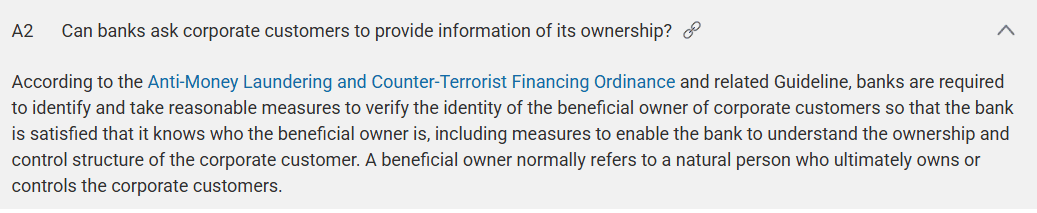
HKMA guidance on banks in Hong Kong requiring beneficial ownership information
The HKMA defines the UBO as the individual who ultimately owns or controls the corporate customer, either directly or indirectly.
This process allows the bank to identify the individuals who actually own or control the company. In this stage, the bank focuses on three things:
- Cross-checking personal information: Verifying the identity documents, residential addresses, and personal details of each director, shareholder, authorised representative, and other individuals subject to verification;
- Identifying the ownership structure: Checking the shareholder list, ownership percentages, and relationships between the relevant individuals and entities;
- Clarifying ownership and control: Reviewing the ownership structure and control mechanisms to identify the individual who ultimately owns or controls the company, directly or indirectly.
For a company with multiple ownership layers or entities in several countries, the bank will request an ownership structure chart and documents proving the relationships between the relevant parties.
If identity, address, or control information is incomplete, the company must provide additional documents or explanations as requested by the bank.
Stage 3: Assessing the business activity and expected transactions
After verifying the parties, the bank assesses the plausibility of the business and the need for the account. This step falls under KYC and Anti-Money Laundering (AML), in line with HKMA's AML/CFT guidance. The goal is to confirm the expected transactions fit the business model.
Based on our international banking support, make the following clear:
- Business model and sector: state the products or services, the operating markets, and how the company generates revenue;
- Purpose of the account: clarify the need to receive payments, transfer to suppliers, manage cash flow, or run international transactions;
- Expected transaction profile: assess the values, frequency, transaction types, and relevant countries to confirm the fit with the declared activity;
- Proof of business activity: match the business plan to contracts, quotations, purchase orders, or correspondence with customers and suppliers where needed;
- Source of funds and transaction purpose: show the documents explaining the funds entering the account and the purpose of the expected payments;
- Online presence: a live website and social pages help the bank verify real products and services, especially for a company in technology or services.
4. Should you open a traditional or a digital bank account in Hong Kong?
Traditional and digital banks in Hong Kong differ in the opening process, the depth of the review, and the range of financial services.
- Traditional bank: fits a company that wants a long-term banking relationship, credit products, and deeper financial transactions;
- Digital bank: fits a company that prioritises speed, remote registration, and multi-currency transactions.
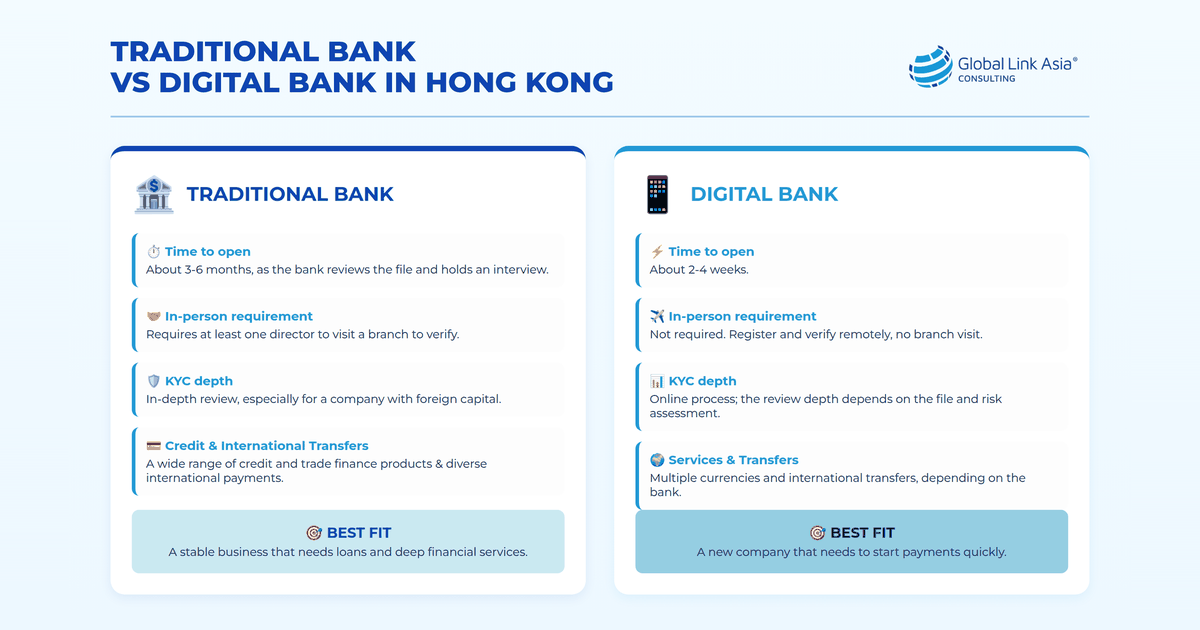
Comparison of Traditional Banks and Digital Banks in Hong Kong
To help you pick the model that fits your operations, our banking experts compared a traditional bank and a digital bank in Hong Kong:
| Criteria | Traditional bank | Digital bank |
| Time to open | About 3-6 months, as the bank reviews the file and holds an interview | About 2-4 weeks |
| In-person requirement | Requires at least one director to visit a branch to verify | Register and verify remotely, no branch visit |
| KYC depth | In-depth review, especially for a company with foreign capital | Online process; the review depth depends on the file and risk assessment |
| Credit services | A wide range of corporate credit and trade finance products | Limited or not yet offered |
| International transfers | A diverse set of international payments and transfer services | Multiple currencies and international transfers, depending on the bank |
| Best fit | A stable business that needs loans and deep financial services | A new company that needs to start payments quickly |
You do not have to choose only one model. Combining a traditional account with a digital one helps you meet your payment and finance needs at each stage of growth.
- For a new company: open a digital bank account first to start receiving and making payments quickly, especially when you have no transaction history yet;
- For a company already running steadily: consider adding a traditional bank account in Hong Kong to access loans, trade finance, and a long-term banking relationship.
With over 10 years of experience in international business consulting, we provide comprehensive support for opening a bank account in Hong Kong, from document preparation to the completion of the entire application process.
5. The 9 mistakes that stall or sink a corporate account application in Hong Kong
The most common mistake is submitting only the incorporation papers while leaving out the UBO, the source of funds, and the business activity.
Errors such as a blurry scan, an expired document, or inconsistent details make the bank ask for supplements. The result is a longer review or a rejected file.
To help you self-check before you submit, our banking expert, Erik, listed the 9 most common errors, how they show up, and how to fix each one:
| Common error | How it shows up | How to fix it |
| Only preparing the incorporation documents | You submit the CI and the BRC but leave out the directors, shareholders, UBO, ownership structure, and business activity. | Prepare the full set of details on the directors, shareholders, UBO, registered address, operating location, purpose of the account, and expected transactions. |
| Not clarifying the shareholder structure and UBO | You list only the direct shareholders and hide the intermediate layers or the person who ultimately owns or controls. | Draw up the ownership structure chart, showing the shareholding at each level and the ultimate owner or controller. |
| Incomplete or expired personal documents | An expired passport, missing proof of residential address, or name, date of birth, and nationality that differ across the documents. | Check the validity of the passport and ID, prepare the proof of residential address the bank requires, and add a translation or notarisation if asked. |
| No proof of business activity | You provide only the incorporation certificate without explaining the products, services, target market, and partners. | Prepare a company profile, a website, product or service materials, sales contracts, invoices, purchase orders, and a business plan for a new company. |
| No clear source of funds and transaction purpose | You can't prove the capital contribution, the UBO's source of wealth, or the expected revenue and cash flow. | Prepare the bank statements, capital proof when asked, expected revenue, monthly transaction values, transaction countries, currencies, and the account's purpose. |
| Using one generic document set for every bank | You don't adapt the file to each bank's acceptance criteria, verification requirements, and review process. | Check your target bank's requirements and sort the documents by ownership structure, country of incorporation, and the residency of the directors and shareholders. |
| Submitting the wrong document type | You confuse the CI with the BRC, or submit only one of the two. | Cross-check the bank's document list and submit both the CI and the BRC. |
| Submitting an expired BRC | The BRC is no longer valid at the time of submission, and per the IRD the BRC is valid for 1 or 3 years. | Check the expiry date printed on the BRC and renew it per the IRD's notice sent before the renewal period. |
| Describing the business too broadly | You list services you plan to do in the future, so the business description no longer matches the supporting evidence. | Describe only the activity you are running, and separate out any expansion plan, clearly labelled as expected. |
6. How to keep your Hong Kong bank account active after opening
Keep regular transactions, update your information promptly, and respond on time when the bank runs a periodic review. That is how you keep the account stable after opening.
6.1. How does the bank review customer files periodically?
The bank reviews customer files periodically, or when an event requires further verification of the company's documents.
The bank is responsible for keeping customer information complete and up to date. It runs a review when it finds the current information is no longer complete or needs supplements to meet the review requirements.
When you receive a review notice, complete the form and provide the requested documents. The file usually includes:
- Updated information on the directors and shareholders;
- Information on the Ultimate Beneficial Owner (UBO);
- Proof of address and contact details;
- Information on the business activity, source of funds, and the company's transactions.
Provide a complete file on time to meet the bank's review and reduce the risk of the account being restricted for lack of information.
6.2. What happens to an inactive account?
An inactive account is usually one with no transactions for 6 months or more, excluding transactions made by the bank such as interest and fees.
Most banks charge a fee for this type of account, and some suspend certain services, such as ATM use.
To keep the account stable, our banking experts recommend that you:
- Maintain real transactions through the account, in line with the declared purpose;
- Notify the bank promptly when a director, shareholder, address, or contact detail changes;
- Read every bank letter carefully and respond on time;
- Make sure the registered phone number can receive the verification messages when you manage the account from overseas.
7. How we help you open a corporate bank account in Hong Kong
With more than 10 years of experience in international business consulting and working with banks such as OCBC, UOB, DBS, Standard Chartered, and Citibank, we provide a comprehensive service for opening a bank account in Hong Kong for your company.
We help you prepare and complete every requirement, from assessing the file and choosing the bank to submitting and activating the account. Our support covers:
- We review your legal information, ownership structure, residency status, and transaction needs;
- We recommend the bank that fits your country of incorporation, shareholder structure, business model, and account use;
- We guide you to collect, complete, and review the documents the bank requires;
- We track the review process and help you prepare the information when the bank asks for verification or supplements;
- We help you finish the activation and walk you through what you need to use the banking services;
- We remind you and help prepare the documents when the bank runs a periodic review.
8. FAQs about opening a corporate bank account in Hong Kong
Before you send the file, review 6 things:
- Accuracy: the company name, personal details, and registered data must match across the documents;
- Document quality: the scan must be sharp, complete, and not cut off any important information;
- Validity period: the documents must be valid and meet the bank's issue-date requirement;
- Signature and notarisation: the documents must be signed, notarised, or legalised as specifically required;
- File format: check the format, size, and file naming per the bank's instructions;
- Consistency: the ownership structure, business activity, and source of funds must match the documents you have provided.
Banks in Hong Kong must check customer information before opening an account to prevent money laundering, terrorist financing, and other financial crime.
Under the Anti-Money Laundering and Counter-Terrorist Financing Ordinance (Cap. 615), the bank must run Customer Due Diligence (CDD), which includes:
- Verifying identity;
- Verifying the ownership structure;
- Checking the source of funds;
- Assessing the business activity.
Some banks must also follow internal rules from their head office or from a regulator in another country.
So each bank has its own document list and verification process. You should check the requirements of the bank you plan to choose to prepare the right file.
Per HKMA, you can ask the bank to reconsider through a review, supply more information, or apply at another bank (HKMA). Specifically:
- Ask the bank to state the reason: contact the team handling the file to find out why it was not approved;
- Ask the bank to review the file again: if the rejection came from missing documents or unclear information, request a re-review;
- Apply at another bank: if the bank keeps its decision, choose a bank whose acceptance criteria better fit your ownership structure, country of incorporation, and business model.
Not in every case. The in-person requirement depends on each bank's policy, the account type, and the review result.
- For a traditional bank: some banks such as HSBC, Standard Chartered, and Bank of China (Hong Kong) require or arrange an in-person meeting with a director, representative, or authorised person. The bank uses the meeting to verify identity, understand the business, and confirm the purpose of the account.
- For a digital bank: the file is submitted and verified online. You need to meet the bank's conditions on country of incorporation, residency status, and ownership structure.
With over a decade of experience serving as a trusted partner to more than 750 business owners seeking professional development and breakthroughs in the international market, we are an expert strategic corporate service provider helping you incorporate and operate successfully in 10 different countries
Our areas of expertise include:
- Strategic Consulting and Company formation in over 10 different countries worldwide such as Singapore, Hong Kong, the U.S., Australia, Thailand, Malaysia, and offshore destinations like BVI, Belize, Seychelles, and more.
- Account opening for personal and corporate bank accounts, as well as setting up PayPal and Stripe gateqays in countries like Singapore, Hong Kong, and the U.S..
- Tax Consulting and Preparation for SFRS IFRS financial reports, corporate income tax returns, VAT/GST (Value Added Tax/Goods and Services Tax), and more.
- Opreation support:
- Registered adress;
- Foreign consular legalization;
- Trademark and patent protection registration in Singapore and the US;
- Employment Pass application in Singapore and Hong Kong;
- Website design, international SIM number provision;
- DUNS registration.
With over 10 years of experience and a team of experts with 5 to 25 years of experience (international standard certifications) as well as direct partnerships with institutions such as OCBC, UOB, DBS, PayPal, and Stripe, we are proud to offer professional, legal, transparent, sustainable services with no hidden costs.


Global Link Asia Consulting Pte. Ltd. is pleased to announce the publication of the above insightful and informative article on our official website, Global Link Asia Consulting on 20th November 2026. The copyright for this article is exclusively held by Global Link Asia Consulting Pte. Ltd. Any unauthorized reproduction or distribution of this content without our express written permission is strictly prohibited. We value the protection of our intellectual property and appreciate your cooperation in adhering to these guidelines. Thank you for your continued support of Global Link Asia Consulting Pte. Ltd.
The content in this article is provided by Global Link Asia Consulting for general informational purposes only. It is intended as a helpful reference and should not be considered legal, tax, accounting, banking, or other professional advice. Because laws and regulations can change, and every situation is different, we recommend that individuals and businesses seek independent professional advice before making any important decisions. Global Link Asia Consulting is not responsible for any loss or damage that may result from relying on the information in this article without obtaining appropriate professional advice.
 470 North Bridge Road, #05-12, Bugis Cube, Singapore (188735).
 Unit 308, 3/F, Chevalier House, 45-51 Chatham Road South, Tsim Sha Tsui, Hong Kong.
 90/14-17 Sathorn Thani Building 1, 8th Floor, North Sathorn Road, Silom, Bangrak, Bangkok 10500.
 12th, Felix Alley Building, 151/1-2 Nguyen Van Troi, Phu Nhuan District, Ho Chi Minh City, Vietnam.