+65 83551210
You've done the hard part. You've registered your company abroad, navigated the paperwork. Now you need to open a business bank account.
The bank asks one simple question:"Can you provide proof of address?", and everything stalls.
For business owners trying to open a bank account overseas, proof of address is one of the most misunderstood and frustrating requirements in the entire process.
- What counts?
- Does it need to be a local address in the country where the bank is?
- What if your utility bills are in someone else's name, or you simply don't have any?
- And does a virtual office even qualify?
In this guide, our banking experts at Global Link Asia Consulting will break down exactly
- What a proof of address means in a business banking context;
- Which documents are accepted (and which are quietly rejected);
- What you should pay attention to to speed up your application.
Let’s start by understanding exactly what a proof of address is in the eyes of banking, financial institutions,and government bodies.
1. What is a proof of address?
A proof of address (also known as a proof of residence) is a document that confirms a physical location,either yours as the business owner, or your company's operating address.
Banks use it as a core part of their customer verification process before they open an account.
During our 10+ years of helping international business owners with their overseas company setup and account opening, a key note you must remember is that a valid proof of address is always a recent document, issued within the last 90 days, that clearly displays a name and a physical street address.
A proof of address can be a utility bill, a bank statement, a government-issued letter, a lease agreement, or a number of other official documents depending on the country and institution.
2. How many types of proof of address are there?
Here is the critical point that you may miss. Oftentimes, you think that you just need to prepare and send any proof of address you can access to, and expect the receivers to accept it.
The reality is, when you open a business bank account or talk with any government bodies overseas, banks typically require two separate proofs of address, not one:
1. Personal proof of address confirming where you, the business owner or director, personally live;
2. Business proof of address confirming where your company operates from.
In our cases of helping our clients, many international founders arrive at the application stage expecting to provide one document and are surprised to learn they need both. Understanding this distinction from the start will save you significant time and frustration.
3. Why do banks ask for proof of address when you try to open a business/personal bank account?
They are legally required to collect this information under international frameworks known as KYC (Know Your Customer) and AML (Anti-Money Laundering) regulations.
These rules exist to prevent fraud, money laundering, terrorism financing, and tax evasion, and compliance is taken seriously at every level of the banking system.
- In the United Kingdom, banks operate under guidelines from the Financial Conduct Authority (FCA).
- In the United States, the governing legislation includes the Bank Secrecy Act and the USA PATRIOT Act.
- In the UAE, the Central Bank of the UAE (CBUAE) sets the standards.
- For Hong Kong, it is the Anti-Money Laundering and Counter-Terrorist Financing Ordinance (AMLO), and
- For Singapore, it is the Terrorism (Suppression of Financing) Act (TSOFA) and other recent legislations
The specifics differ by jurisdiction, but the underlying principle is the same: the bank must verify who you are and where you operate before it allows money to move through your account.
4. What documents are accepted as proof of address?
Based on our experience, not all documents carry equal weight. Banks have clear, if sometimes unpublished, hierarchies for which documents they trust.
To help you understand our point, here is a practical overview of what is commonly accepted and what frequently gets rejected for personal proof of address and business proof of address.
4.1. Personal proof of address
These documents are widely accepted across most banking jurisdictions to verify the personal residential address of a business owner, director, or beneficial owner:
| Proof of address (from suggested to should-have) | What it is? |
| Government-issued correspondence | Letters from your tax authority (such as HMRC in the UK, the IRS in the US, or the local tax office in Singapore or the UAE), voter registration notices, or social security letters |
| Utility bills (electricity, gas, water) | The gold standard in most countries, dated within 90 days |
| Lease or rental agreement | A signed agreement showing your current residential address. |
| Mortgage statement | Accepted in most jurisdictions, sometimes up to 6 months old |
| Driver's licence | Accepted in some countries (including the UK and Australia) if it shows your current residential address |
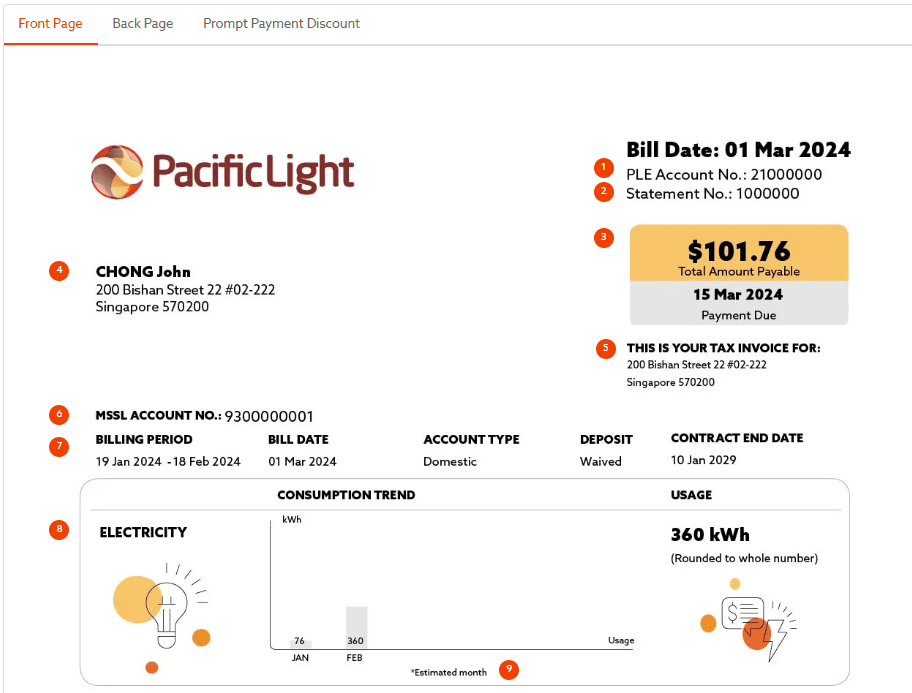
Example of a utility bill from Pacific Light Singapore
4.2. Business proof of address
These documents verify the operating or registered address of your company:
| Proof of address | What it is? |
| Certificate of Incorporation or Articles of Organization | The foundational document establishing your company's registered address |
| Government business registration notice | Official correspondence from the registrar confirming your company's address |
Business lease or commercial tenancy agreement | A signed lease for your office, co-working space, or flexi-desk |
| Utility bill in the company's name | Where applicable, such as an office with utilities registered to the business |
5. What proof of address banks will reject?
This is where many applications fail. We see this from business owners who try to open a business bank account in another countries on their own.
They failed to follow the bank guideline from the start, reach out to us, and our banking experts stepped in and advised them the correct way to do.
One pattern that consistently trips up in our supporting case: using a phone or internet bill. This is usually not a best practice since most banks do not accept them as a proof of address.
In the United States, mobile and broadband bills are generally not accepted, the bank will ask specifically for electricity, gas, water, or an official government document instead.
The following are commonly rejected and will cause delays or outright refusals:
| Proof of address | Why it is rejected? |
| PO Box address | Not a physical street address; banks require a traceable physical location |
| Mobile phone bills | Not accepted in many jurisdictions, it is considered insufficient evidence of residence
|
| Internet/broadband bills | Rejected at most banks; policy varies elsewhere. For example: |
| Generic virtual mailbox addresses | Without supporting documentation, these are treated the same as PO Boxes |
| e.g., Sky, Virgin Media) | |
| (unless specified by the organisation) |
6. The 3 suggestions we want you to follow
Based on our experience advising business owners through the bank account opening process across multiple jurisdictions, we’ve collected a wealth of real-world situations where almost everything can happen during compliance review.
From missing documents and address mismatches to unexpected verification requests, these are the 3 mistakes that most consistently cause applications to be delayed, flagged for additional review, or rejected altogether:
A tax letter, a utility bill, or a lease agreement in your language must be accompanied by a certified English translation before most banks will accept it.
If your proof of address (proof of residence) differs from the address on your utility bill by even a small detail. This is normal situation since a person can own many properties in many areas in their country. Or your proof of address contains a missing apartment number, slightly different street name format.
The bank's compliance team will flag it and ask for clarification. Ensure every document uses precisely the same address format.
As noted above, you almost always need both personal and business proof of address. Arriving with only one is a common reason applications are returned for additional documentation.
7. How can we help you open a corporate/personal bank account with ease?
Proof of address is more than just paperwork. It is how banks verify that your business and personal presence are legitimate, traceable, and compliant with international regulations.
If you are opening a business bank account overseas, understanding this requirement early can save weeks of delays, rejected applications, and unnecessary back-and-forth with the bank.
Start by identifying which documents your target bank actually accepts, and make sure the information matches exactly across all records.
Then focus on the gaps most likely to slow down your application:
- Expired or inconsistent documents;
- Utility bills under another person’s name;
- Virtual office addresses that may not qualify;
- Documents issued outside the bank’s accepted timeframe.
The sooner you prepare the right proof of address, the faster you can move from company setup to fully operational banking.
If you need support to open a corporate bank account for your overseas company in Singapore, Hong Kong, the United States, the United Kingdom, Canada, and 10 other countries, we can help you
- Recommend the right bank and the right bank account for your needs;
- Support you in opening a reliable, trusted digital bank account or traditional bank account;
- Prepare necessary documents for account opening;
- Schedule an appointment with a Singapore bank representative;
- Monitor and assist in opening personal bank accounts (physical and digital).
8. FAQs about proof of address
If your goal is to open a bank account overseas, a registered agent's address does not count as personal proof of address for the beneficial owner or director, and banks will still require a separate document showing where you personally live.
It depends on the bank. Fintech providers generally accept virtual street addresses if they are genuine CMRA-registered physical addresses with supporting documentation from the provider.
Traditional banks typically require additional evidence that you actually use a virtual address for your business or your personal use, and may reject virtual office addresses entirely.
A bank or credit card statement from another institution, a government-issued letter (tax notice, voter registration), a signed lease or rental agreement, or a co-working space membership agreement. Any of these, dated within 90 days and showing your name and address, will be accepted by most banks.
A utility bill (electricity, gas, or water) or a bank statement from another financial institution, dated within 90 days and showing your full name and physical address. These are the most universally accepted documents across all major banking jurisdictions.
With over a decade of experience serving as a trusted partner to more than 750 business owners seeking professional development and breakthroughs in the international market, we are an expert strategic corporate service provider helping you incorporate and operate successfully in 10 different countries
Our areas of expertise include:
- Strategic Consulting and Company formation in over 10 different countries worldwide such as Singapore, Hong Kong, the U.S., Australia, Thailand, Malaysia, and offshore destinations like BVI, Belize, Seychelles, and more.
- Account opening for personal and corporate bank accounts, as well as setting up PayPal and Stripe gateqays in countries like Singapore, Hong Kong, and the U.S..
- Tax Consulting and Preparation for SFRS IFRS financial reports, corporate income tax returns, VAT/GST (Value Added Tax/Goods and Services Tax), and more.
- Opreation support:
- Registered adress;
- Foreign consular legalization;
- Trademark and patent protection registration in Singapore and the US;
- Employment Pass application in Singapore and Hong Kong;
- Website design, international SIM number provision;
- DUNS registration.
With over 10 years of experience and a team of experts with 5 to 25 years of experience (international standard certifications) as well as direct partnerships with institutions such as OCBC, UOB, DBS, PayPal, and Stripe, we are proud to offer professional, legal, transparent, sustainable services with no hidden costs.


Global Link Asia Consulting Pte. Ltd. is pleased to announce the publication of the above insightful and informative article on our official website, Global Link Asia Consulting on 27th May 2026. The copyright for this article is exclusively held by Global Link Asia Consulting Pte. Ltd. Any unauthorized reproduction or distribution of this content without our express written permission is strictly prohibited. We value the protection of our intellectual property and appreciate your cooperation in adhering to these guidelines. Thank you for your continued support of Global Link Asia Consulting Pte. Ltd.
The content in this article is provided by Global Link Asia Consulting for general informational purposes only. It is intended as a helpful reference and should not be considered legal, tax, accounting, banking, or other professional advice. Because laws and regulations can change, and every situation is different, we recommend that individuals and businesses seek independent professional advice before making any important decisions. Global Link Asia Consulting is not responsible for any loss or damage that may result from relying on the information in this article without obtaining appropriate professional advice.
 470 North Bridge Road, #05-12, Bugis Cube, Singapore (188735).
 Unit 308, 3/F, Chevalier House, 45-51 Chatham Road South, Tsim Sha Tsui, Hong Kong.
 90/14-17 Sathorn Thani Building 1, 8th Floor, North Sathorn Road, Silom, Bangrak, Bangkok 10500.
 12th, Felix Alley Building, 151/1-2 Nguyen Van Troi, Phu Nhuan District, Ho Chi Minh City, Vietnam.