+65 83551210

You've sent your passport, proof of address, and shareholder details to your Corporate Service Provider (CSP) in Singapore. The company formation file should be moving forward.
Then the email lands.
"Could you please provide additional information regarding the source of source of fund, source of wealth? We may also need to arrange a short video call to verify identity."
No red flags. No accusation. Just a request. But now you're wondering: is something wrong with my file?
You're not alone. Founders from Vietnam, Indonesia, the Philippines, and beyond ask us this question every week. The short answer: your file is probably fine. What you're seeing is Enhanced Customer Due Diligence, or ECDD.
ECDD is the step-up check that every CSP in Singapore must run when a file carries higher-than-normal risk. It digs into who you are, who truly owns the company, where your money comes from, and what the company is for. It does not mean you are under suspicion.
In this guide, we'll break down what actually matters:
- What ECDD is and how it differs from the standard KYC/CDD you already went through;
- Which situations trigger ECDD and how to spot them in your own file;
- Why the CSP is legally required to ask for those extra documents;
- What to prepare so you don't end up in a back-and-forth loop;
- How we help you move through the process without delays.
Let's get into it.
Quick summary
- ECDD is an additional check that runs alongside and after standard KYC; it does not replace it;
- ECDD typically kicks in when the file involves a PEP, a high-risk country, a complex ownership structure, or an unusual transaction;
- The documents mainly prove where your wealth and the specific funds come from;
- The file must be approved by the CSP's senior management and monitored more closely for the life of the engagement.
1. What is ECDD? How does it differ from standard KYC/CDD?
KYC is the umbrella term for the customer-identification step that every CSP in Singapore must perform. In Singapore's legal framework, this step is formally called Customer Due Diligence (CDD). CDD has three levels: simplified, standard, and enhanced. ECDD is the enhanced level, applied when a file carries elevated risk, to clarify wealth, fund flows, and the company's purpose.
1.1. What is KYC and why must every customer complete it?
KYC (Know Your Customer) is the broad term for identifying and verifying a customer before a service is provided. In Singapore's legislation, the same activity is called Customer Due Diligence (CDD).
The goal is straightforward: the CSP needs to know who you are, who truly owns the company, so that corporate services cannot be used to launder money or fund terrorism.
This is a legal obligation from the state, not a policy each CSP invents on its own. Under the Corporate Service Providers Act 2024 and ACRA's guidance (2025), every registered CSP must complete CDD before it provides a service.
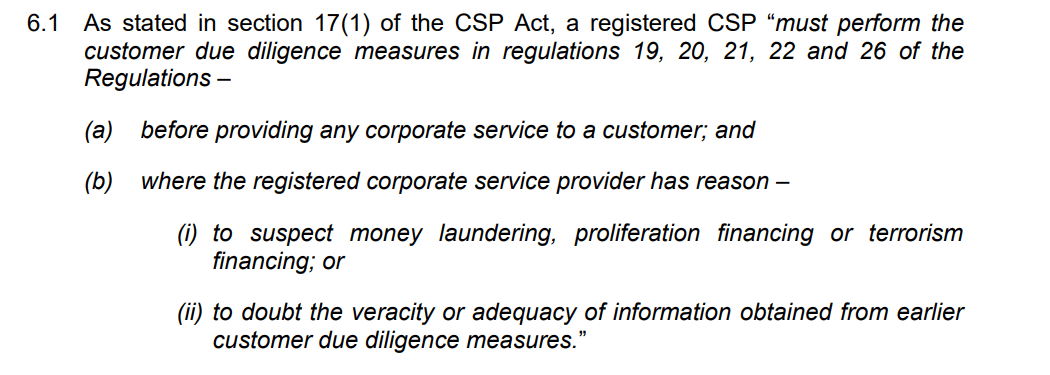
When a CSP must complete customer due diligence under Singapore's CSP Act?
A standard KYC file typically includes the minimum information set out in ACRA's guidance:
- Full legal name (including any alias) or registered company name;
- Passport number, identification document number, or company registration number;
- Residential or registered-office address, with a contact phone number;
- Date of birth or company incorporation date;
- Nationality of each individual (including multiple nationalities) or the country of incorporation for entities;
- Details of directors, shareholders, and beneficial owners;
- Information needed for sanctions screening and risk assessment.
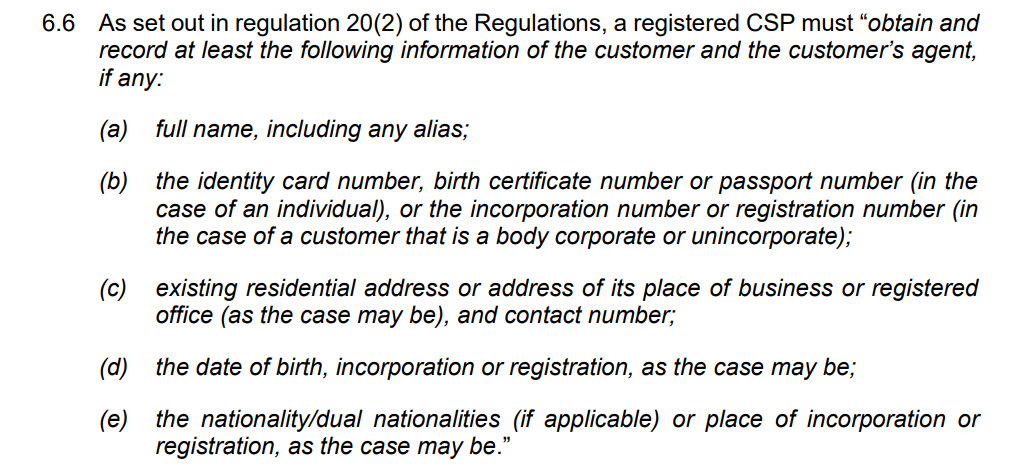
Minimum information a CSP must collect during KYC in Singapore
When a new client comes in, the CSP verifies identity, identifies the legal representative, and determines the Beneficial Owner (BO) - the natural person who ultimately sits behind the company.
The CSP identifies the BO in a fixed order: first, look at ownership; if that is unclear, look at control; if still unclear, the BO is the person who manages the company. Then the CSP cross-checks the information against reliable sources and keeps a copy of the documents.
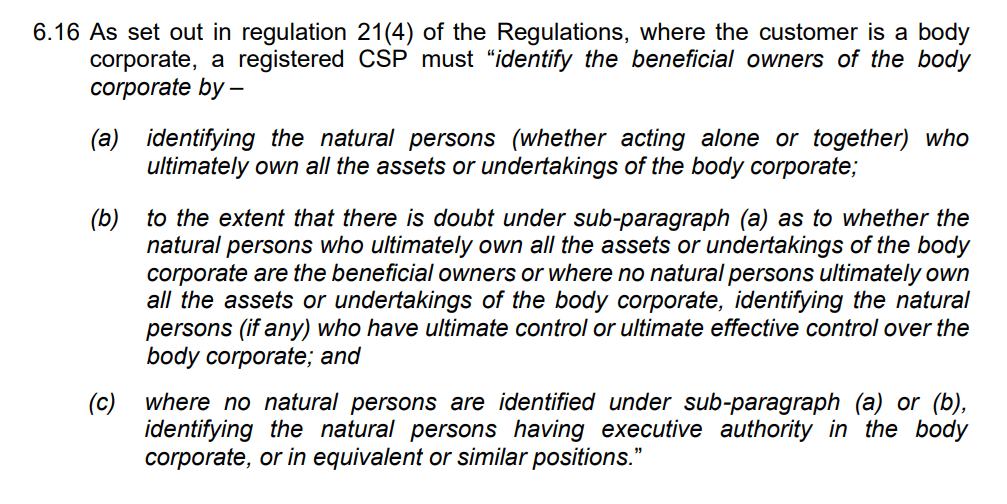
ACRA guidance for CSPs: three steps to identify a company's beneficial owner - ownership, control, then management
The depth of the check is not the same for every client. The CSP must assess risk to pick the right level of due diligence and record the basis for its decision.
1.2. Which three levels of customer due diligence apply in Singapore?
CDD does not apply the same way to every client. The CSP must assess the risk of each file to pick one of three levels and record the basis for its decision.
To help you see what level of preparation your file will require before you submit, Thomas Trần, Head of Legal at GLAC, mapped the three CDD levels below based on ACRA's guidance and the risk-assessment outcome:
| Level | When it applies | What it involves |
| Simplified CDD | The file is assessed as low-risk and meets specific conditions | Identify and verify the customer, representative, and BO; run standard screening checks; |
| Standard CDD | The file carries a normal risk profile | Verify identity, legal representative, beneficial owner, and related information; |
| Enhanced CDD (ECDD) | The file carries elevated risk | Collect additional information on wealth, funds, business purpose; obtain senior-management approval; increase ongoing monitoring; |
Simplified CDD does not mean the CSP skips checks. The CSP still verifies identity, identifies the representative and BO, and runs sanctions screening. This level cannot be applied when the customer is from or resides in a FATF "blacklist" country, or when the CSP suspects money laundering or terrorist financing.
On the other end, ECDD is not a blanket requirement for every client. The CSP applies it only when the file carries high-risk factors or when the regulations mandate it. For everything in between, the CSP picks the level that fits the actual facts.
1.3. What exactly is ECDD?
ECDD (Enhanced Customer Due Diligence) is the heightened level of CDD. The CSP still runs the full KYC process, but goes deeper and adds extra steps. ECDD is mandatory when the file carries higher-than-normal risk.
In Singapore, every CSP must perform ECDD in line with the Corporate Service Providers Act 2024, the CSP Regulations 2025, and ACRA's guidance. The purpose is to prevent money laundering and other illicit financial activity.
Where KYC answers "who is the customer?", ECDD drills into three further questions:
- Source of Wealth: Where did the customer's overall assets come from? Business income, salary, investment returns, a property sale, an inheritance?
- Source of Funds: Where did the specific sum being used for the subscription, transaction, or service payment come from?
- Business purpose: Why is the company being formed, what sector will it operate in, and does the ownership-and-control structure make sense for that sector?
Beyond collecting that information, the CSP must submit the file for senior-management approval, document the findings in writing, and step up monitoring for as long as it continues to serve the client.
2. Why does your Singapore company face enhanced due diligence?
A CSP can be required to run ECDD when it identifies a customer, representative, beneficial owner, or transaction that carries elevated risk. Common triggers include politically exposed persons, high-risk countries, complex ownership structures, and unusual transactions.
To help you spot whether your file may fall under ECDD, Thomas Trần, Head of Legal at GLAC, summarised the main scenarios below:
| Scenario | What ACRA requires |
| Foreign PEP | ECDD is mandatory |
| Singapore PEP, international-organisation PEP, or former PEP | Risk-based assessment; ECDD is mandatory when the transaction or service is high-risk |
| FATF "call for action" country (blacklist) | ECDD is mandatory |
| FATF "increased monitoring" country (grey list) | Factor into the risk assessment; apply ECDD where warranted |
| Unclear actual activity or purpose of the ownership structure | ECDD is mandatory |
| Complex, unusually large, or purposeless transaction | ECDD is mandatory |
| Other risk factors per the CSP's internal assessment | Depends on each CSP's own criteria |
A PEP (Politically Exposed Person) is a natural person who holds or has held a prominent public function in Singapore, in a foreign country, or in an international organisation.
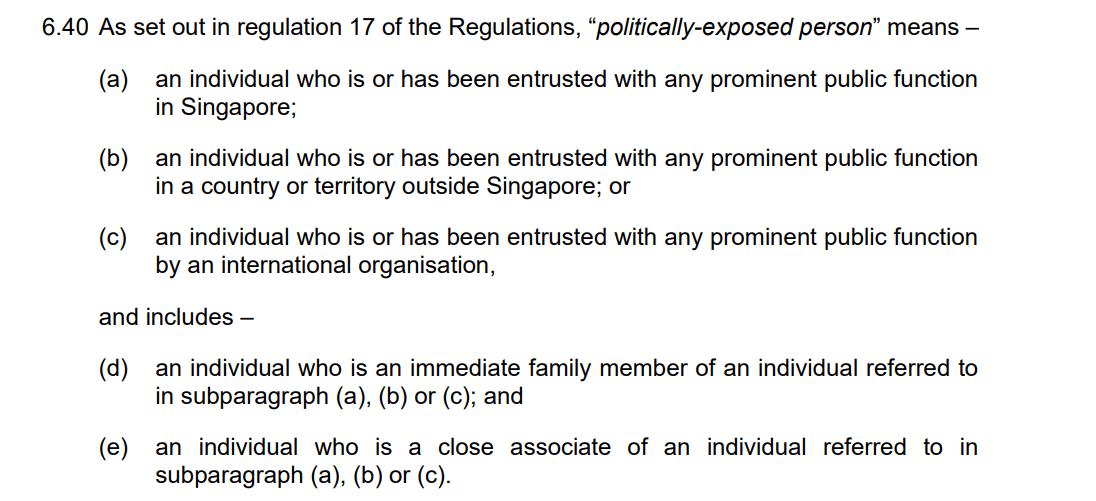
Definition of a politically exposed person (PEP) under Singapore's regulations
The group can include:
- Heads of state or heads of government;
- Senior ministers and officials;
- Members of the legislature;
- Senior judicial or military officials;
- Leaders of state-owned enterprises;
- Senior political-party officials;
- Senior management of international organisations.
Close family members and close associates of a PEP are assessed at a similar level. Mid-level and junior officials do not fall in this group.
Not every PEP connection is treated the same way:
- Foreign PEPs (including their immediate family and close associates): the CSP must always run ECDD and maintain enhanced monitoring;
- Singapore PEPs, international-organisation PEPs, or former PEPs: the CSP may use a risk-based approach to decide whether and how much ECDD to apply, taking into account the influence the person still holds after leaving office. This risk-based approach cannot be used when the transaction or service is high-risk; in that case the CSP must run ECDD regardless.
Being a PEP does not mean the person broke any law. It is a risk factor that the CSP must weigh during due diligence, based on the role, the level of influence, and the nature of the business relationship.
The Financial Action Task Force (FATF) publishes lists of countries and territories with identified gaps in their AML/CFT systems.
Two groups come up most often in practice:
- FATF "call for action" countries (the blacklist): these carry the most serious deficiencies and trigger a mandatory ECDD requirement;
- FATF "increased monitoring" countries (the grey list): these are under FATF follow-up to improve their financial-controls framework. The CSP weighs this factor during its risk assessment.
So when a customer is from, or resides in, a FATF "call for action" country, the CSP must run ECDD. For a country under enhanced monitoring, the CSP needs to factor the jurisdiction into its overall assessment and decide on the appropriate measures.
One important nuance: the assessment does not look only at where the customer lives. Nationality (including dual or multiple nationalities), the country where the company is incorporated, and other related factors can all come into play.
Because FATF lists change over time, you should check the latest status at the FATF's official site before preparing your file.
Under ACRA's ECDD guidance, the CSP must run enhanced due diligence when it cannot tell whether the company has a genuine business activity, or when it does not understand why the company is structured the way it is. Situations that can trigger extra document requests include:
- The company is owned through multiple layers of intermediate legal entities;
- Shareholders and actual controllers sit in different countries;
- A nominee shareholder or nominee director is used, but the commercial purpose has not been explained;
- The ultimate natural-person owner or controller cannot be identified;
- The reason for forming the company has not been explained satisfactorily.
For example, a Vietnamese investor incorporates a Singapore company, which in turn holds a subsidiary in a third country. If the CSP cannot trace the ultimate controller or does not understand the purpose behind the multi-tier structure, the company may be asked to provide an ownership chart, registration documents, and an explanation of the planned operations.
A multi-tier structure does not automatically equal high risk. What matters is whether you can clearly explain the ownership links, the control rights, and the commercial purpose of each entity.
The CSP must run ECDD on transactions that are unusually large, structurally complex, or lack a clear business rationale.
The CSP also needs to watch for significant changes in the transaction pattern or customer information during the service period. If new risk indicators appear, the CSP may need to re-assess the file and apply a proportionate level of due diligence.
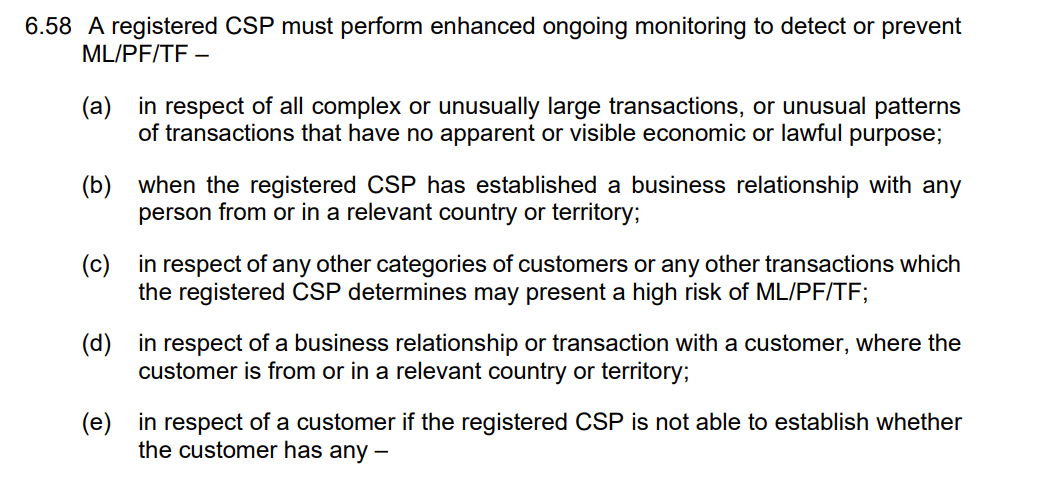
Situations that require enhanced monitoring after a CSP begins serving a client
To reduce the chance of back-and-forth, you should be ready to document:
- The purpose of the transaction;
- The origin of the funds involved;
- The relationship between the parties;
- The economic or commercial basis for the transaction;
- The fit between the planned transaction and the company's stated business activity.
For instance, if you plan to fund your share subscription with proceeds from a share sale, the sale agreement and the receipt of payment can help show where the capital comes from.
Beyond the scenarios above, each CSP also defines additional categories of customers or transactions that warrant closer scrutiny, based on its internal risk-assessment process.
When conducting the assessment, ACRA requires the CSP to consider at least the following groups of factors:
- Customer-related: nationality, country of incorporation, PEP status, number of ownership layers, and industry;
- Country-related: the customer's home country or country of residence, and the country where the CSP operates - including the quality of financial controls, corruption levels, and political stability;
- Service and transaction-related: whether the onboarding is done remotely, whether the company has a clear business purpose, and whether a nominee is used without a stated reason;
- Singapore's overall risk landscape: Singapore publishes periodic risk assessments by country, sector, and entity type. CSPs use these as a baseline when reviewing files.
This is why the same customer can receive different document requests from different CSPs, depending on the service, the jurisdiction, and each provider's internal risk model.
Five questions to help you assess whether you may face ECDD
Based on Ryan, Corporate Advisory Specialist at GLAC, has seen in supporting clients, you should run through the following five checks before submitting your Singapore company-formation file:
- Is any shareholder, director, or beneficial owner a PEP, or closely related to one?
- Does any party hold nationality, reside in, or operate in a country on a relevant risk list?
- Is the company structured through multiple legal-entity layers, or does it use a nominee?
- Do you plan to carry out a large, complex, or hard-to-explain transaction?
- Are you forming the company remotely, without an in-person meeting with the CSP?
If the answer to any of these is "yes," start preparing the relevant documents early. That said, this is a reference checklist, not a definitive tool. The final call rests with the CSP's risk assessment and the applicable legal requirements.
3. Why do CSPs in Singapore request additional documents?
The CSP carries a direct AML compliance duty to ACRA. The request for extra documents is a mandatory procedure, applied uniformly to every file at the same risk level.
A CSP supports activities such as company formation, provision of a registered address, and certain corporate-administration tasks. Because of the nature of those services, they can be exploited to conceal the true owner or the purpose behind a transaction.
That is why a CSP registered with ACRA must comply with the current rules on customer identification, risk assessment, and enhanced due diligence.
The request for additional documents is not one provider's internal policy. It is a legal requirement that applies to every high-risk file, regardless of which CSP is handling it.
On top of the standard checks, the CSP must take additional measures proportionate to the risk level:
- Understand the purpose of the service. The CSP needs to know what business you plan to run, why you chose Singapore, and who truly owns or controls the entity;
- Obtain senior-management approval. Under ACRA's guidance, an ECDD file must be approved by the CSP's senior management before the service starts or continues. This is an internal approval step, not a government licence application;
- Verify source of wealth and source of funds. The CSP can request documents that evidence income, assets, and the origin of the funds used for the subscription or transaction;
- Document the assessment in writing. The verification results and the risk-assessment rationale must be recorded for compliance purposes.
After the service begins, the CSP continues to monitor the client. For high-risk files, that monitoring is typically more frequent, and you may be asked to update information when a significant change occurs.
When you do not meet the CSP in person, the provider must apply additional verification measures under ACRA's guidance (ACRA, Guidance for CSPs, para 6.47, 2025).
Under that guidance, for a new company formation or a shelf-company purchase, the CSP must conduct a live video call with at least one of the following:
- At least one proposed director (excluding a nominee director);
- At least one proposed shareholder holding 50% or more of the shares;
- The authorised representative of that shareholder (when the shareholder is a company).
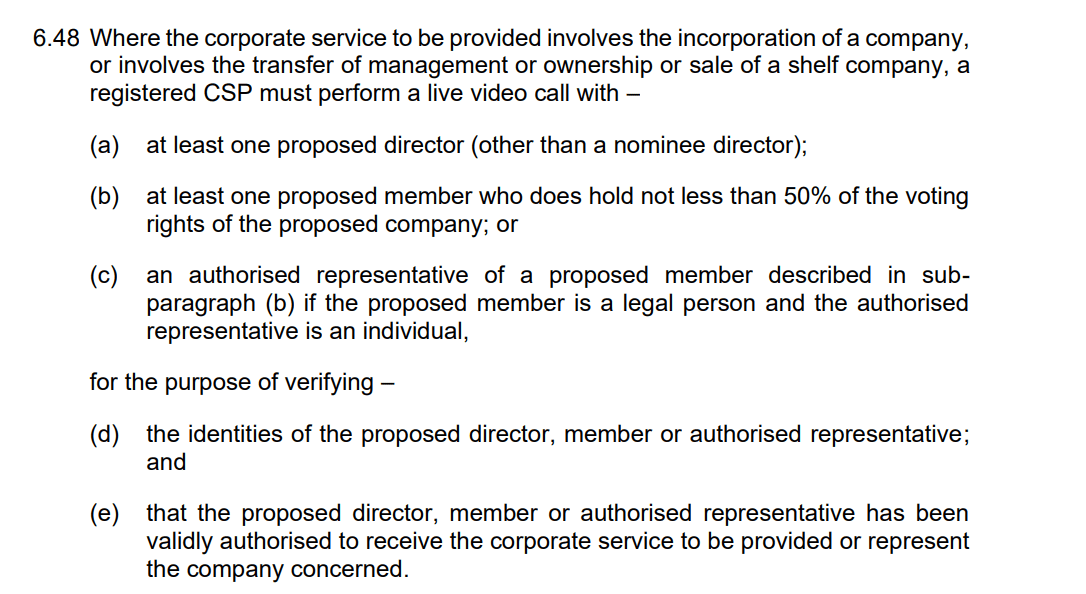
Video-call verification requirement for company formation or shelf-company transfers in Singapore
For foreign clients with a higher risk profile, the CSP may also request certified copies of identification documents.
This is why investors in Vietnam forming a Singapore company remotely may be asked to:
- Join a video call for identity verification;
- Provide a copy of the passport or identification document;
- Submit a certified copy if requested;
- Explain the shareholding structure and the actual controller;
- Provide documents on the planned business activity and the source of capital.
You should confirm the exact document list with the CSP handling your file, because the specific requirements can vary from case to case.
The CSP must finish the required due-diligence steps before it can start the service. For an ECDD file, the processing stage also includes collecting extra documents, verifying information, and obtaining management approval.
So, when the documents are not yet in, the service typically cannot begin until the file is complete.
In addition, if you are unable to provide the required information, the CSP will note the gap and follow up under its internal process.
To avoid delaying your timeline, have a direct conversation with the CSP: which documents are missing, why they are missing, and when you expect to have them. Explaining clearly from the start helps the file move faster.
Under ACRA's guidance, the CSP must retain customer-due-diligence records for 5 years from the date it stops providing the service. The file must be detailed enough to reconstruct the entire service history if a regulator asks to review it.
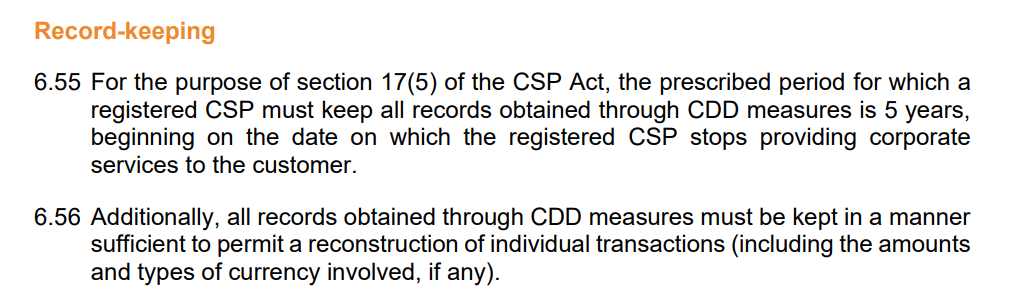
How long a CSP must retain customer due-diligence records in Singapore
The records can include identification documents, beneficial-owner information, source-of-funds evidence, risk-assessment results, and all notes made during the due-diligence process.
The retention requirement serves the compliance obligation and may respond to requests from a competent authority. At GLAC, your information and documents are managed in line with our Privacy and Data-Protection Policy.
4. What should your business prepare for a smooth ECDD process?
When ECDD applies, you do not necessarily have to submit every financial or asset document you hold. The specific list depends on your profile, the source of capital, the ownership structure, and the CSP's request.
In practice, preparation centres on three questions: where did the wealth come from, where did the specific funds come from, and what is the company for.
The two terms are often requested together, but they do not mean the same thing:
- Source of Wealth refers to how you built your overall net worth and the origin of the capital you are subscribing. It can include business income, salary, investment gains, a property or asset sale, or an inheritance;
- Source of Funds refers to the origin of the specific sum tied to the service relationship with the CSP. For example, when forming a company or changing shareholders, it is the share-subscription amount or the share-transfer payment.
Example. An investor uses SGD 200,000 from the sale of an apartment to subscribe to a Singapore company.
In that case:
- Source of funds: the SGD 200,000 received from the apartment sale;
- Source of wealth: how the investor originally accumulated and owned the apartment - for example, from business income or savings built up over several years.
To explain this clearly, the investor may need the property sale agreement, the receipt of payment, and documents that evidence how the asset was built, depending on what the CSP asks for.
The key point: the documents must show a link between the declared financial source and the actual funds used in the transaction.
To help you prepare the right set of documents and avoid multiple rounds of follow-up, GLAC's corporate advisory experts compiled the table below, based on ACRA's guidance and our hands-on experience supporting real files:
| What needs verifying | Documents that may be requested |
| Customer identity | Passport, identification document, or equivalent legal ID; |
| Ownership structure | Shareholding chart, company registration records, information on the controller and ultimate beneficial owner; |
| Source of wealth | Audited financial statements (where available), business records, property or asset documents, income or profit evidence; |
| Source of funds | Bank statements, transfer receipts, asset or share-transfer agreements, documents related to the specific sum being used; |
| Business purpose | Description of planned activities, a business plan, or a written explanation of why the company is being formed in Singapore; |
| Remote verification | Video call, certified copies of documents where requested; |
| Supplementary information | Occupation, net-worth scale, and a narrative on the transaction, tailored to the file's specifics; |
The table above is for reference. You do not need to prepare every item if the CSP has not asked for it or if a document is irrelevant to your case.
So, rather than sending a large batch of scattered papers at once, prioritise the documents that directly answer: where the funds come from, how the wealth was built, and what the company is for.
Drawing on our experience supporting clients, GLAC's specialists recommend running through the following six points before you submit:
- Names, addresses, and document numbers match across every document;
- Non-English documents come with a certified translation;
- A short written note explains where the subscription capital or transaction funds came from;
- A clear ownership chart shows who owns the company, all the way down to the ultimate natural person;
- Documents are still valid and the scans are sharp and legible;
- You notify the CSP immediately when a shareholder or ultimate owner changes.
5. How we help you complete ECDD in Singapore?
Global Link Asia Consulting (GLAC) is a CSP registered with ACRA. With more than 10 years in operation, we have advised and supported individuals and companies from over 10 countries - Singapore, Hong Kong, Thailand, the U.S., and more - through corporate-service procedures.
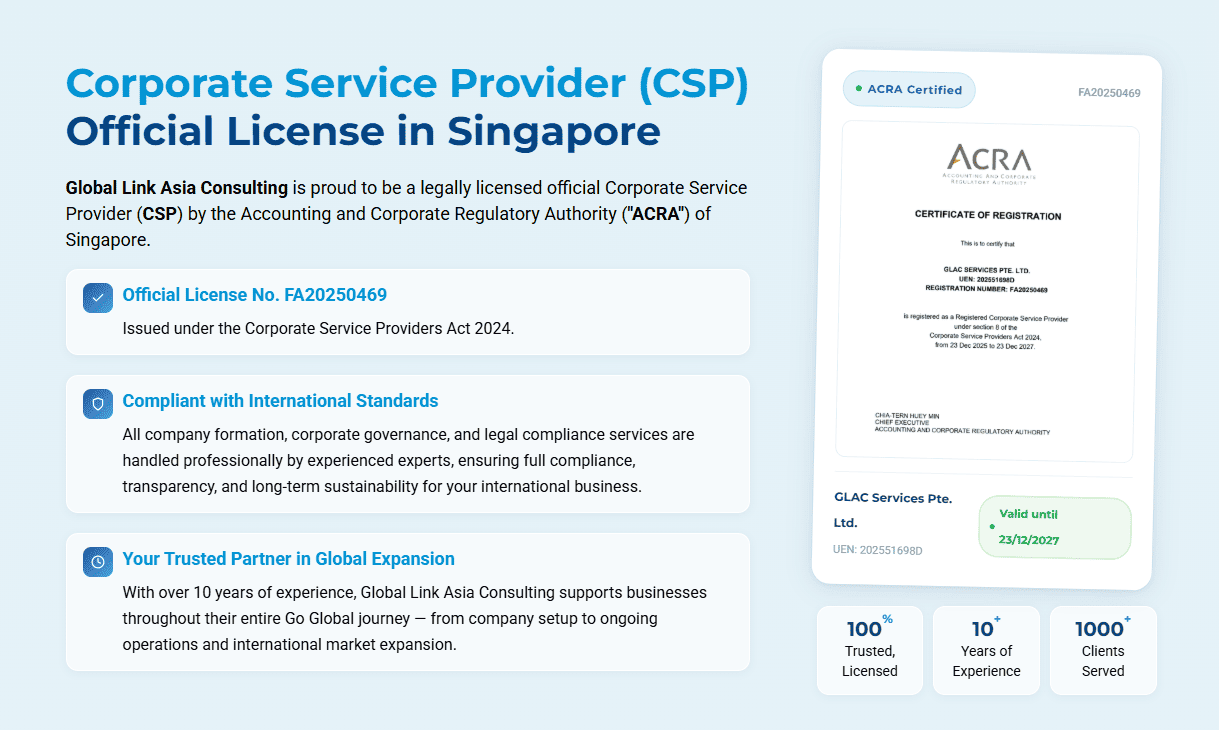 GLAC Services Pte. Ltd. is a Corporate Service Provider (CSP) registered with ACRA under the Corporate Service Providers Act 2024.
We walk alongside you throughout the ECDD process:
- We explain clearly why your file requires ECDD and what each request is looking for;
- We guide you through the document list that fits your specific file, so you submit neither too much nor too little;
- We review the consistency of your file before it enters the verification workflow;
- We advise and support end-to-end on related services such as company formation, bank-account opening, tax and accounting, and ongoing compliance in Singapore;
- We keep your information and documents confidential under GLAC's Privacy and Data-Protection Policy.
If you need guidance on ECDD or the Singapore company-formation process, our team is ready to walk you through the next steps.
6. FAQs about ECDD in Singapore
Not all of them. ECDD is not a blanket procedure for every company. Whether it applies depends on the risk factors in the file - PEP status, country of origin, ownership complexity, transaction nature - and the applicable regulations.
A Singapore company with a straightforward structure and a clear business purpose may only need to complete standard CDD, while another file may require enhanced due diligence.
The bank needs to understand where the money in a transaction originated and whether the cash flow is consistent with the customer information you declared.
Depending on the case, the bank may request bank statements, commercial contracts, financial reports, share-subscription evidence, or a document explaining how the underlying wealth was built. The specific request depends on the bank's risk assessment and the regulations that apply.
Start at the formation stage, when you open the bank account, and before your first international transaction. Keeping a complete set of legal documents, subscription receipts, commercial contracts, accounting reports, and beneficial-owner information from the outset makes it far easier to respond when an enhanced-due-diligence request arrives.
If the company has multiple ownership tiers or receives capital from several sources, building a clear explanatory file from day one makes a practical difference.
KYC (or CDD) focuses on verifying the customer's identity, the legal representative, and the beneficial owner. ECDD adds layers that clarify source of wealth, source of funds, business purpose, and other risk factors. Completing KYC does not exempt you from ECDD when the file is assessed as requiring the enhanced level.
Yes, a video call is required. When an in-person meeting is not possible, the CSP must conduct a live video call with at least one of the following: a proposed director (excluding a nominee director), a proposed shareholder holding 50% or more of the shares, or the authorised representative of that shareholder if the shareholder is a legal entity.
To keep the verification smooth, agree with the CSP in advance on who will join the call and which documents to have ready.
With over a decade of experience serving as a trusted partner to more than 750 business owners seeking professional development and breakthroughs in the international market, we are an expert strategic corporate service provider helping you incorporate and operate successfully in 10 different countries
Our areas of expertise include:
- Strategic Consulting and Company formation in over 10 different countries worldwide such as Singapore, Hong Kong, the U.S., Australia, Thailand, Malaysia, and offshore destinations like BVI, Belize, Seychelles, and more.
- Account opening for personal and corporate bank accounts, as well as setting up PayPal and Stripe gateqays in countries like Singapore, Hong Kong, and the U.S..
- Tax Consulting and Preparation for SFRS IFRS financial reports, corporate income tax returns, VAT/GST (Value Added Tax/Goods and Services Tax), and more.
- Opreation support:
- Registered adress;
- Foreign consular legalization;
- Trademark and patent protection registration in Singapore and the US;
- Employment Pass application in Singapore and Hong Kong;
- Website design, international SIM number provision;
- DUNS registration.
With over 10 years of experience and a team of experts with 5 to 25 years of experience (international standard certifications) as well as direct partnerships with institutions such as OCBC, UOB, DBS, PayPal, and Stripe, we are proud to offer professional, legal, transparent, sustainable services with no hidden costs.


Global Link Asia Consulting Pte. Ltd. is pleased to announce the publication of the above insightful and informative article on our official website, Global Link Asia Consulting on 11th November 2026. The copyright for this article is exclusively held by Global Link Asia Consulting Pte. Ltd. Any unauthorized reproduction or distribution of this content without our express written permission is strictly prohibited. We value the protection of our intellectual property and appreciate your cooperation in adhering to these guidelines. Thank you for your continued support of Global Link Asia Consulting Pte. Ltd.
The content in this article is provided by Global Link Asia Consulting for general informational purposes only. It is intended as a helpful reference and should not be considered legal, tax, accounting, banking, or other professional advice. Because laws and regulations can change, and every situation is different, we recommend that individuals and businesses seek independent professional advice before making any important decisions. Global Link Asia Consulting is not responsible for any loss or damage that may result from relying on the information in this article without obtaining appropriate professional advice.


 470 North Bridge Road, #05-12, Bugis Cube, Singapore (188735).
 Unit 308, 3/F, Chevalier House, 45-51 Chatham Road South, Tsim Sha Tsui, Hong Kong.
 90/14-17 Sathorn Thani Building 1, 8th Floor, North Sathorn Road, Silom, Bangrak, Bangkok 10500.
 12th, Felix Alley Building, 151/1-2 Nguyen Van Troi, Phu Nhuan District, Ho Chi Minh City, Vietnam.